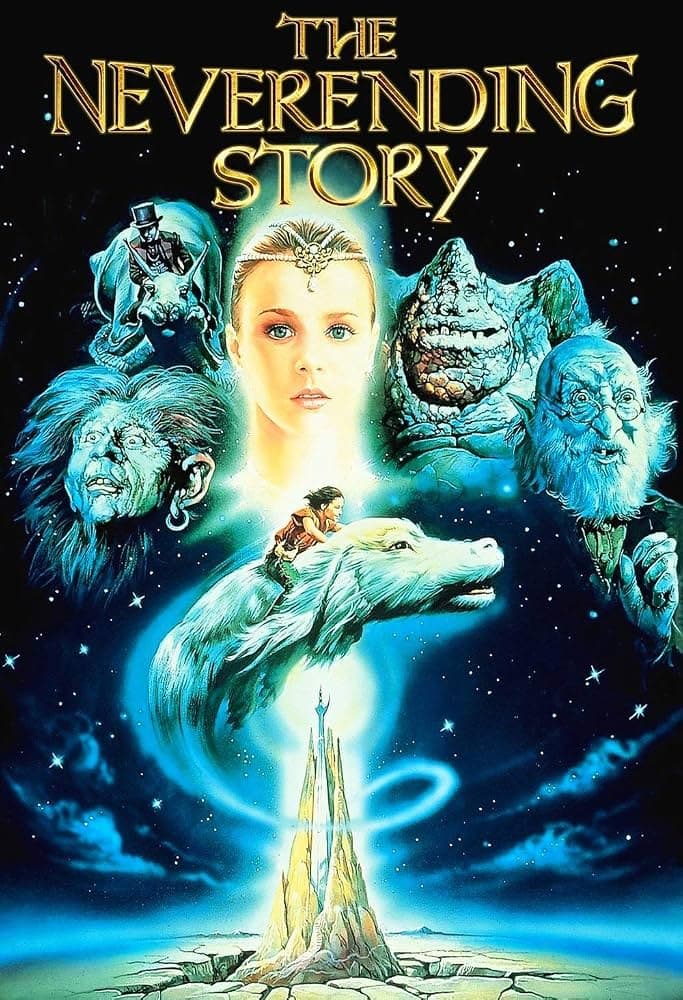
The NeverEnding Story
A boy, a book and a disappearing world — imagination as the only weapon left.
The setup
You remember the kid with the book. Bastian Balthazar Bux is the hinge that makes The NeverEnding Story feel alive: he finds a massive book, hides away to read it and, as he reads, the invented world starts speaking back. That simple idea — storytelling that heals and fights back — is why people still return to Wolfgang Petersen’s 1984 fantasy.
THE MOVIE
Bastian Balthazar Bux is still the reason this movie works
Put simply: The NeverEnding Story sets up two things at once — a huge, mysterious book and a shy boy who needs it. Bastian discovers and reads The NeverEnding Story, and that act of reading is the film’s spark; the book narrates the adventures of Atreyu while the real-world boy sits in an attic and becomes part of what he reads.
That framing gives the film an emotional fuse. Bastian is presented as a bullied, timid child whose curiosity about books is the engine of the story; his imagination isn’t decoration, it’s the thing that can restore a dying land called Fantasia.
It helps that Petersen keeps the running time trim — 94 minutes — and trusts the setup to carry both the child’s world and the fantasy. By making the reader the pivot, the film turns an ordinary closet of schoolbooks into the most dangerous and hopeful place on screen.
THE SETUP
The idea that sets The NeverEnding Story in motion
The backbone is almost archetypal: a child finds a book, and the book contains a quest. The NeverEnding Story positions Bastian as the reader and Atreyu as the hero inside the pages; the two stories run alongside one another rather than collapsing into a single adventure.
The clever bit is reciprocity. Characters in Fantasia become aware of Bastian as he reads, and the film treats his attention as more than passive consumption — it’s an active link between worlds. That diegetic overlap keeps the stakes intimate: saving Fantasia depends on a human child giving the Childlike Empress a name.
All of which keeps the plot lean. The setup lets the movie move quickly from attic to adventure while keeping the basic engine — imagination and storytelling — visibly turning the gears.
And because the film trusts that basic engine, it can do a lot in a relatively short 94 minutes without feeling overstuffed.
THE CHARACTER
Why Bastian Balthazar Bux matters
Bastian isn’t just a passive audience stand-in. He’s introduced as shy and bullied, yes, but crucially curious — and that curiosity is the narrative’s lifeline. The film makes clear that his act of reading is restorative: his imagination is treated like medicine for a dying world.
Because Bastian brings the book into an attic and hides to read, his interior life gets space. That domestic vulnerability — a frightened kid retreating into stories — is what gives Fantasia its chance. Without Bastian’s attention, the fantasy would remain a book; with it, the fantasy becomes a place that can be saved.
Casting-wise, the movie keeps the focus on the character rather than celebrity. Bastian’s role is to make us believe a book can change reality — and that belief is what the film asks of its audience, too.
UNDER THE SURFACE
The NeverEnding Story has more on its mind than the plot suggests
On the surface it’s a children’s quest: Atreyu must find a cure for the Childlike Empress. Under the surface, the film is talking about imagination and storytelling as acts that save us. The very title is a promise — stories that go on because someone keeps telling them.
The Nothing — the film’s metaphysical threat — works as a readable image: it’s not just a monster, it’s the erosion of hope and dreams. Fantasia is literally being erased the moment people stop believing or caring.
That’s why the reader-story reciprocity matters. If a land of fantasy can be emptied out by human loss of imagination, then the human reader becomes the agency by which it’s restored. The film wants us to feel that naming — the small ritual of giving the Empress a new name — is powerful enough to repair a world.
Finally, there’s a steady belief in childhood courage and agency. It’s children who move the plot, who make the sacrifices and decisions. That emphasis keeps the film emotional without making it heavy-handed.
THE FILMMAKING
How The NeverEnding Story was put together
Two practical credits tell you a lot about what this film feels like: Jost Vacano handled the cinematography and Jane Seitz edited the picture. That pairing gives the movie a steady visual and rhythmic hand — it’s concise, deliberate and avoids meandering.
That discipline helps the film balance its two worlds. With a reliable camera eye and brisk cutting, Petersen keeps Fantasia from becoming a collection of set pieces; instead, the sequences hang together and move the story forward.
In short: the filmmaking choices present the fantasy as a coherent place rather than a series of curiosities, and that coherence is what lets the emotional and thematic ideas land.
PRACTICAL EFFECTS
The effects work that gives The NeverEnding Story its physical personality
A lot of the movie’s personality comes from the way creatures are made tangible. Many of the film’s fantastical beings were realised with practical puppetry and what the credits comfortably call 'Muppet-like' techniques, paired with in-camera tricks, rear projection and optical compositing.
That practical approach matters because it lets human actors interact with three-dimensional creatures on set. Falkor and several other Fantasia creatures exist as performed, operated presences rather than merely composited images, which helps scenes feel immediate.
The upshot is a tactile fantasy: you can sense the mechanics in a way that keeps the film from floating off into pure abstraction.
PURE 80S
The NeverEnding Story could not belong to any other decade
This is an unmistakably 1980s production in its ambitions. It was a high-budget West German film from 1984, with contemporary reporting routinely putting the cost at around DM 60 million — among the most expensive European productions of the period.
That scale mattered because the film sits where European production met English-language international ambition. It exemplifies the era’s co-productions: German studios building a film with clear hopes for a broad, English-speaking market.
Americans noticed the effort. Contemporary reviews compared its special-effects ambitions to other effects-driven fantasies of the decade, placing it in the same conversation as films that were pushing technical boundaries.
And structurally, the decision to adapt roughly the first half of Michael Ende’s book and end with Bastian entering Fantasia fits the decade’s appetite for big, self-contained fantasy statements rather than faithful serialisation.
THE LEGACY
Why The NeverEnding Story still matters
The film’s afterlife is partly domestic: it set up two sequels and a continued franchise, so its story carried on in cinemas through the 1990s.
There’s also a public argument that forms part of its legacy: Michael Ende, the author of the original novel, objected to the film’s deviations and took legal action against the filmmakers. The record shows he publicly contested the adaptation and lost the suit.
And then there’s the title song from the English-language release — a pop theme by Giorgio Moroder and performed by Limahl — which has remained culturally associated with the film and is still widely recognised.
Taken together, the sequel chain, the author’s objections and that enduring pop-song link are the clearest, documented reasons the movie keeps getting mentioned.
THE VERDICT
Does The NeverEnding Story still hold up?
Yes — if you come for the feeling that stories are active things. The film’s core trick is elemental and it still lands: a boy reads a book about a hero, and the act of reading reaches back. That diegetic overlap — the reader affecting the story — is the movie’s emotional currency.
Its central stakes are straightforward and meaningful: Fantasia is being eaten away by The Nothing, and only a human child can name the Childlike Empress to heal the land. That clarity keeps the film honest; it doesn’t get lost in abstruse metaphors because the threat is plainly felt as an erosion of hope and imagination.
There are practical charms, too: the creatures, the set pieces and the rhythm of the film combine to create a world you can step into for 94 minutes. Contemporary reviewers recognised that craftsmanship — Roger Ebert, for example, praised the visual world-building and how the child actors and creatures worked together to create an effects-driven atmosphere.
So should you watch it? If you want a compact, earnest fantasy about the power of reading and the rescue of imagination, yes. It's a film that still asks a simple but unromantic question: what happens when people stop believing in stories — and who will pick up the book when they do?
Share this movie
Keep watching
More movies from the 80s
1984
A Nightmare on Elm Street
A Nightmare on Elm Street: family and the safety of home, and why this 1984 movie still matters.
Read our take →
1984
Splash
A mermaid arrives in New York, a sensible man gets sensible about love — and the rest is splashy business.
Read our take →
1983
Christine
Obsession, adolescence and a car that won't let go.
Read our take →