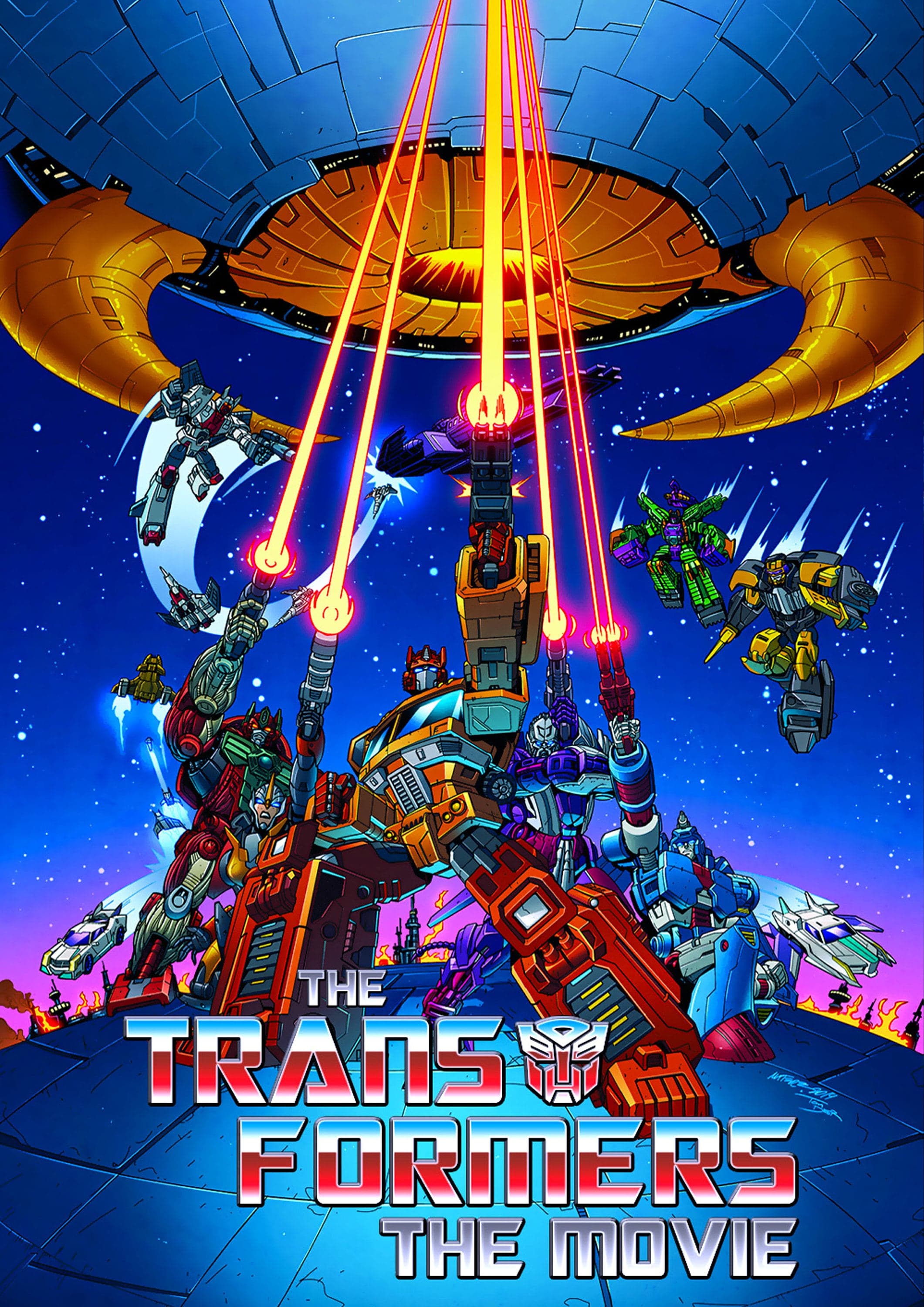
The Transformers: The Movie
A loud, fast, slightly brutal toy advert that somehow turns a brash kid into a leader.
The setup
The Transformers: The Movie is the cartoon that decided to treat Hasbro’s playroom like a battlefield. It opens with a planet-eating menace and never really lets the stakes drop, then asks a very simple question: who will lead once the old guard is gone? For many viewers, the answer — Hot Rod becoming Rodimus Prime — is the single beat that keeps the whole thing interesting.
THE MOVIE
Hot Rod / Rodimus Prime is still the reason this movie works
The film throws you straight into the deep end: a cosmic menace eating worlds and changing the game before the opening credits finish. That prologue makes the stakes feel... indisputable.
Optimus Prime stands where you expect the moral compass to be, and his on-screen death operates as the sacrificial pivot that forces everyone — the Autobots, the plot, and the audience — to reconfigure what comes next.
In the middle of all this are the new toys and new faces: Judd Nelson’s Hot Rod is the brash kid handed an impossible hand, and Nelson Shin’s 85-minute feature races from threat to threat without much fat to spare.
THE SETUP
The idea that sets The Transformers: The Movie in motion
Set in the year 2005 — roughly two decades after the TV show’s second season — the movie takes the existing cartoon world and cranks everything up to feature-film scale.
Its central conflict is two-sided: the Autobots are scrambling to survive and push back a universe-level threat, while the Decepticons are simultaneously splintering and scheming for control. That tension between outside peril and inside chaos keeps the plot moving.
The story was written within the commercial reality of its time: it was produced as a tie-in to the 1986 toyline, so new characters and designs were part of the engine pushing the narrative decisions.
Ron Friedman holds the screenplay credit, with Flint Dille as a story consultant, which helps explain the film’s brisk, almost episodic swing between big set pieces and character beats.
THE CHARACTER
Why Hot Rod / Rodimus Prime matters
Hot Rod arrives as part of the 1986 wave of new characters created for the toyline, which means his existence is both storytelling choice and product placement. That tension is useful: you can see the mechanics, but you also see the possibility.
He’s the film’s coming-of-age figure. The story hands him responsibility he didn’t ask for and watches how a younger, flashier bot copes when leadership is no longer hypothetical.
That arc — a new face growing into the role left by an older generation — is the emotional shorthand the movie keeps returning to, and it gives the chaos a human-sized hinge to rotate on.
Because he was part of the 1986 toy push, Hot Rod’s prominence isn’t accidental. The filmmakers needed a character who could bridge merchandising demands and the story’s appetite for high-stakes change — and he fills that role.
THE PERFORMANCE
Why Orson Welles's performance matters
Orson Welles provided the voice of Unicron, and those sessions were completed shortly before his death. That fact attaches a particular gravity to the role — whether you’re paying attention or not.
The knowledge that these are among Welles’s final recorded film lines gives the movie an odd extra layer: a heavyweight presence in a cartoon about giants and toys.
It’s the kind of casting decision that reads differently once you know the context: the voice becomes not just a villain’s instrument but a small historical moment captured on tape.
UNDER THE SURFACE
The Transformers: The Movie has more on its mind than the plot suggests
Beneath the explosions and the toy introductions, the movie is quietly obsessed with passing authority from one generation to the next. Leadership isn’t assumed here — it’s taken, earned in a hurry or ripped away.
Death and sacrifice are genuine engines in the story. The film uses those beats to reset the playing field and force characters (and the audience) to confront loss as a practical problem, not just a melodramatic moment.
Because the picture was tied to a merchandising cycle, the coming-of-age and leadership transfer beats have a dual purpose: they serve story and they clear the way for new toys to take centre stage.
Finally, the film wears its 80s rock-inflected tone openly: it treats heroics like big solos — brash, amplified and occasionally a little excessive — which matches the movie’s appetite for high-decibel drama.
PURE 80S
The Transformers: The Movie could not belong to any other decade
This was very much a mid-1980s commercial strategy in motion: theatrical features doubling as tie-ins for popular toylines were part of the era’s landscape, and this film sits squarely in that tradition.
The soundtrack choices and the film’s general rock-influenced sensibility lean into 80s pop-music ideas, treating action as if it needs a guitar solo to look convincing.
It was released in 1986 and acts as a bridge from the TV series into a reshaped continuity — a distinctly 80s move, where cartoons and merchandising cycles fed one another in plain sight.
Animation production came via the usual international pipelines of the time, and the movie’s very existence as a Sunbow/Marvel theatrical tie-in places it among a small family of similar projects released in the same year.
THE LEGACY
Why The Transformers: The Movie still matters
The film planted several permanent fixtures into Generation 1 continuity — Rodimus Prime, Galvatron and Unicron all became part of the franchise vocabulary long after 1986.
Orson Welles’s participation is more than a casting curiosity: his Unicron work is recorded as the last film performance he completed, and that fact follows the movie around as a notable piece of trivia with genuine weight.
The picture’s willingness to kill and replace established characters is often singled out in franchise histories; that structural choice altered the toyline-story relationship and made the film a recurring point of discussion about merchandising and risk-taking.
It has also enjoyed repeated home-video restorations and anniversary showings — a sign that, for better or worse, people keep returning to this particular chapter of the Transformers saga.
THE VERDICT
Does The Transformers: The Movie still hold up?
Yes — if your metric is appetite and blunt emotional engineering. The film announces an existential threat from the start, reshuffles the deck with Megatron’s reformatting into Galvatron, and uses Optimum Prime’s sacrificial death to force a narrative and emotional pivot.
That pivot is what keeps it watchable: Hot Rod’s transformation into Rodimus Prime gives the chaos a human-scale through-line. It’s a coming-of-age shoved through a meat grinder, but it’s a through-line nonetheless.
Seen as a product of its moment — a mid-80s, 85-minute, toyline-driven feature directed by Nelson Shin with a rock-leaning soundtrack — it does what it sets out to do briskly and without apology.
If you care about dramatic stakes, a few unforgettable structural decisions, and the odd historical footnote (Orson Welles’ final recorded film role among them), it remains worth a viewing. If you expect subtlety, this isn’t your film. But if you want ambitious, loud and consequential cartoon storytelling, it still delivers.
Share this movie
Keep watching
More movies from the 80s
1986
Aliens
Motherhood, marines and monsters: why Ripley still makes Aliens sing.
Read our take →
1986
Critters
Critters: freedom and family, and why this 1986 movie still matters.
Read our take →
1985
Enemy Mine
Enemy Mine: humanity and mortality and lifespan, and why this 1985 movie still matters.
Read our take →