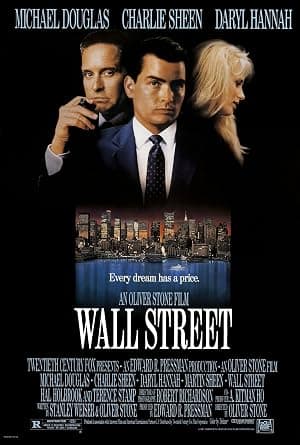
Wall Street
Greed, schooled and sold — and yes, Gordon Gekko still talks like someone you half-admire.
The setup
Oliver Stone's Wall Street is the sort of film that hooks you on a person rather than a plot. It centres on a young broker desperate to climb and a mentor happy to show him how — at a price. Revisit it to see how ambition and temptation are staged as a personal drama dressed in business suits.
THE MOVIE
Gordon Gekko is still the reason this movie works
People keep returning to Wall Street because it gives us a character worth arguing about. At the centre is Gordon Gekko — played by Michael Douglas — a charismatic, amoral corporate raider whose appetite for market dominance and raw accumulation of wealth makes him impossible to ignore.
The film is set in motion by a simple ambition: Bud Fox, an eager junior stockbroker, wants in. He wins a meeting with Gekko and that meeting becomes the engine for the movie — a ladder Bud climbs that turns into complicity when he starts supplying inside information.
Oliver Stone directs a drama that reads like a morality play dressed as a crime story: greed and ambition are not background noise here, they’re the fuel. That concentration on personal temptation — and the cost of choosing power over principle — is why the film still gets talked about.
THE SETUP
The idea that sets Wall Street in motion
At its clearest, Wall Street is about a young professional trying to prove himself inside an ecosystem that rewards results above everything else. Bud Fox is that junior stockbroker, hungry to move up at Jackson Steinem Co., and he actively seeks out Gekko to get there.
The story’s tension comes from a neat, believable mechanism: access. Once Bud scores a meeting, the way he uses privileged information — insider tips and corporate takeover tactics — becomes the plot engine, and the moral cost of those choices ramps up from there.
What works is the straightforward pressure the setup applies to Bud: the lure of status and money pushes him into actions that test his loyalty to a very different world — his father, his upbringing, and any ethical limits he might have had.
It is tidy storytelling. The film doesn’t rely on mystery so much as escalation: ambition opens a door, and everything that follows shows what waits on the other side.
THE CHARACTER
Why Gordon Gekko matters
Gordon Gekko is written and staged as ambition at full volume. Michael Douglas plays him, and the script presents Gekko as a persuasive, amoral figure whose aim is market dominance and the accumulation of power and wealth.
What makes Gekko memorable isn’t a single line so much as the way he embodies an argument: success is measured by control and accumulation. He operates as mentor and corrupter to Bud Fox, offering not only deals but a worldview that is hard to resist when you want to get ahead.
The film even gives Gekko a domestic life — the production used a Bridgehampton mansion to represent his home — which underlines how his financial ambitions translate into real social and personal status.
There’s one more practical proof of how central the character is: the role brought Michael Douglas an Academy Award for Best Actor, a fact that underlines how much the film leans on Gekko as its dramatic fulcrum.
THE PERFORMANCE
Why Michael Douglas's performance matters
There’s a practical reason the film keeps returning to Gekko: Michael Douglas’s portrayal earned the film one of its most visible honours — the Academy Award for Best Actor in 1988.
That award signals that the industry saw Gekko as more than a stock-market caricature; he was a central dramatic force around which the movie turns.
Whether you read that recognition as approval of the character’s ideas or of the performance’s craft, it cements Gekko as the performance the film depends on.
UNDER THE SURFACE
Wall Street has more on its mind than the plot suggests
Under the trading-room banter and takeover manoeuvres, Wall Street is arguing about what the pursuit of money does to people. Greed and ambition are presented as forces that reshape loyalties — particularly the tug between a new life of luxury and the roots Bud still has back home.
That mentor–corruptor dynamic is central: Gekko provides the lessons, Bud pays the tuition, and the moral cost is the implicit syllabus. The film stages corruption as pedagogy.
Family versus ambition is threaded through the story; Bud’s choices aren’t abstract misdeeds, they’re betrayals of a working-class code, which gives the drama a human weight beyond stock prices and boardroom deals.
Finally, the picture is, in part, a critique of its own era: it takes aim at a corporate culture that prizes takeover prowess and financial ruthlessness, and it pins that critique to recognisable moments — including elements of Gekko’s rhetoric that were inspired by contemporary figures in finance.
THE FILMMAKING
How Wall Street was put together
Oliver Stone assembled a clear technical team around the film. Robert Richardson handled the cinematography while Claire Simpson is credited as the editor; Stewart Copeland composed the original music.
Those credits matter because they mark the film as a piece of craft: Stone’s story needed collaborators who could make the world of high finance feel immediate and, where necessary, theatrical.
You don’t need an encyclopedic knowledge of camera technique to notice that the film is designed to keep attention on people and choices rather than abstract graphs. The credited cinematographer and editor provided the practical framework for that focus.
And the score by Stewart Copeland gives the picture its rhythm, helping scenes move between tension, seduction and courtroom consequence without losing narrative momentum.
PURE 80S
Wall Street could not belong to any other decade
Wall Street is a movie born of its moment. It was conceived and released into an environment defined by aggressive corporate raiding, insider-trading scandals and a takeover culture that dominated headlines.
Gekko’s rhetoric — and parts of his speech — drew on real contemporary figures in finance, which made the film read like a dramatised response to the excesses of the late 1980s.
Timing sharpened the film’s edges: it opened in December 1987, just a month after the October stock-market crash, a recent public event that shaped how audiences and promoters thought about a film about markets and morals.
Saying the film is 'of the 80s' isn’t nostalgia here so much as accuracy: its central concerns and the people it sketches are products of that particular corporate moment.
WATCHING IT NOW
What has aged — and what hasn't
A lot of the film’s longevity comes down to one figure: Gekko. Retrospectives often point to him as a shorthand for 1980s financial excess, and over time he has become an ambiguous cultural figure — a villain for some, an alluring model of success for others.
The personal conflicts — especially the friction between Bud’s ambition and his loyalty to his father — still read cleanly. That family-versus-ambition tension keeps the stakes human and makes the film more than a procedural about markets.
Even practical choices remain serviceable: the movie’s New York locations and the Bridgehampton mansion that stands in for Gekko’s home still make the world feel lived-in rather than a studio abstraction.
So while some viewers may approach it as a period piece, the central moral questions and the way they play out in people’s relationships keep the film watchable.
THE LEGACY
Why Wall Street still matters
Part of Wall Street’s afterlife is simply a line and a figure. The film elevated Gordon Gekko into a widely recognised cinematic shorthand for financial excess, and one of the movie’s lines has lodged itself in lists of memorable quotes.
That enduring image is tied to Michael Douglas’s continued identification with the role; his Best Actor Oscar for the film remains a prominent part of how people remember it.
Stone’s decision to revisit the character decades later reinforces that Gekko’s story felt like more than a closed chapter — the film created a cinematic figure people wanted to interrogate again.
THE VERDICT
Does Wall Street still hold up?
Yes, Wall Street still works — particularly as a drama about choices. At its heart is Bud Fox, an ambitious junior broker whose decision to seek out Gordon Gekko sets the moral engine running; that inciting meeting, and Bud's subsequent supplying of inside information, is the plot’s pivot.
What keeps the film engaging is how those headline mechanics — insider tips, takeover tactics, confidential leaks — are tied to personal loyalties. The screenplay deliberately frames the story as a cautionary tale about the seduction of wealth and the real cost of fraudulent practices.
The cast of characters reinforces the argument: Gekko represents opportunistic accumulation, Lou Mannheim offers an older, more restrained code of conduct, and Darien functions as both a romantic figure for Bud and his entry into Gekko’s elite world. Those relationships make the stakes feel human rather than schematic.
So if you approach Wall Street expecting a tidy morality play with teeth, you’ll find one. It’s a drama from 1987 directed by Oliver Stone that runs long enough to breathe — 121 minutes — and it still asks the same uncomfortable question: what do you give up to win?
Share this movie
Keep watching
More movies from the 80s
1987
Extreme Prejudice
Extreme Prejudice: greed and authority, and why this 1987 movie still matters.
Read our take →
1987
Less Than Zero
Less Than Zero: family and friendship, and why this 1987 movie still matters.
Read our take →
1987
Raising Arizona
A robber who wants a nursery more than a life of crime — and it’s the contradiction that keeps the laughs coming.
Read our take →