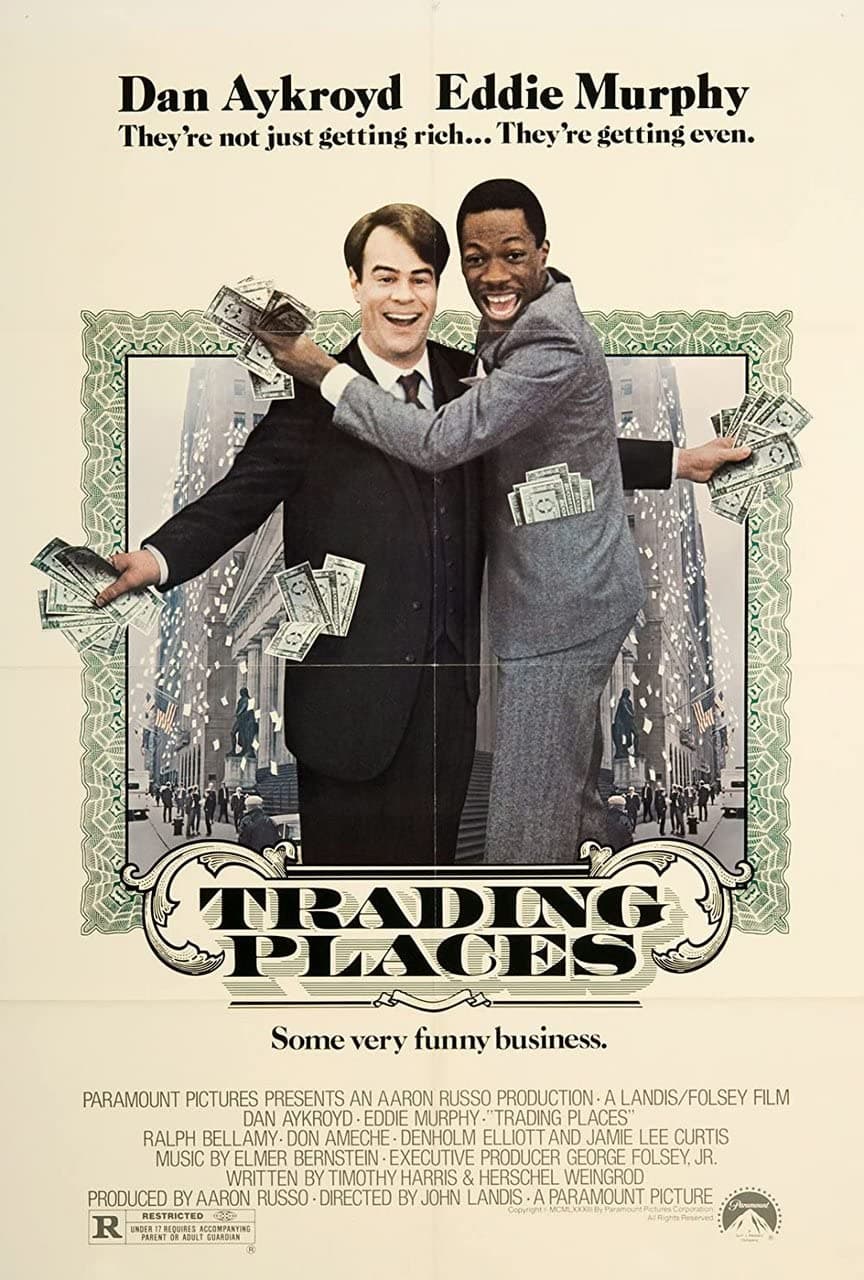
Trading Places
A rigged bet, a culture-swap and Louis Winthorpe III — still very funny, still very sharp.
The setup
Trading Places hooks you with a simple, wickedly mischievous idea: two very rich men bet they can swap a polished broker and a street hustler and watch what happens. It’s a comedy that dresses up as a social experiment, and at its centre is Louis Winthorpe III — the man you love to see unmade and, eventually, remade.
THE MOVIE
Louis Winthorpe III is still the reason this movie works
People still talk about Trading Places because it begins with a deliciously nasty experiment: two affluent brothers secretly swap the lives of a successful commodities broker and a street hustler as a bet on nature versus nurture. That premise gives the film both its jokes and its teeth.
More than the pratfalls and wisecracks, what keeps the whole thing anchored is Louis Winthorpe III — an upper-class broker whose world is pulled out from under him. Watching how he is stripped of status and forced to adapt gives the comedy stakes you actually care about.
John Landis directed the film in 1983 and, in under two hours, he and the writers rig together a bright, satirical comedy that uses class-swapping as a way to poke at who gets opportunities and who does not.
THE SETUP
The idea that sets Trading Places in motion
The engine of the film is straightforward: two wealthy brothers design a social experiment that trades the lives of a polished commodities broker and a hustler from the street. It’s petty, cruel and perfectly cinematic.
From that wager comes the central conflict. One man is framed and dispossessed; the other is elevated to high society. Both must survive the consequences until they realise the truth and turn the tables.
The film keeps a clever through-line to focus the stakes: the final confrontation between the protagonists and their antagonists pivots on a commodity-market con involving a falsified crop report and trading in frozen concentrated orange juice futures.
Set across several weeks over the Christmas and New Year period, the story moves between Philadelphia and New York and lets the role-swap play out as both social farce and a revenge plot.
THE CHARACTER
Why Louis Winthorpe III matters
Louis Winthorpe III is the movie’s fulcrum because he’s the obvious person to push. He arrives as an entitled, upper-class commodities broker and the film delights in unpicking the clothes and assumptions that keep him insulated.
The comedy depends on him being recognisably privileged: his fall has to feel real so the audience can enjoy the reversal without losing sympathy. That’s what gives the later beats weight — it’s not just a gag, it’s a life interrupted.
His relationship with Ophelia, a frank and resourceful sex worker, matters because it moves him beyond caricature. She provides practical help and emotional ballast when his world collapses, which stops the film from being cruel for cruelty’s sake.
Put simply: Louis is memorable because the movie makes his loss consequential and his recovery believable within the film’s comic logic.
UNDER THE SURFACE
Trading Places has more on its mind than the plot suggests
At face value it’s a role-reversal comedy. Under the surface, it’s a neat exercise in testing whether behaviour springs from birth or circumstance. The wager at the heart of the plot makes the movie explicitly about nurture, not nature.
Closely tied to that is class and social mobility. The swap asks who gets doors opened for them, and why — the film makes the answer obvious: opportunity is often a function of where you start rather than anything innate.
Greed and market corruption sit cheek-by-jowl with the social satire. The trading-floor scheme that resolves the story is not just a plot device; it’s also a way for the film to lampoon how markets can be gamed and how fortunes turn on inside information.
Finally, there’s identity and role-playing. Characters don costumes and manners as currency. For a comedy, Trading Places uses disguise and performance to say something about how much of 'self' is genuine and how much is learned.
THE FILMMAKING
How Trading Places was put together
The movie wears its mainstream-comedy construction proudly: it’s tightly plotted, moves at a steady clip and balances broad set-pieces with quieter character moments.
Behind that structure are the names that shaped the look and pace: Robert Paynter is the credited cinematographer, and Aaron Russo produced while Gene Rudolf is credited as production designer. Those collaborators helped make the city-to-country jumps and trading-floor scenes feel cohesive.
Shooting on real locations — from Philadelphia to New York — gives the film a grounded physicality that the script then plays off. The production choices keep the satire readable: you always know what’s at stake and where the scene sits in the game the characters are playing.
In short, the craft keeps the jokes from floating: the filmmaking is efficient and purposeful, built to serve the premise and the characters rather than to call attention to itself.
PURE 80S
Trading Places could not belong to any other decade
Released in 1983, Trading Places sits squarely in the early-80s moment when mainstream comedies mixed broad farce with sharper satirical teeth. That balance helped films of the period reach big audiences while still making pointed observations.
It was part of the wave that helped cement Eddie Murphy as a major movie star, and the film’s commercial success — among the top-grossing North American releases of 1983 — shows it landed with the public as well as critics.
The production’s city locations and its appetite for spiky, topical humour feel of their moment, but not in a way that dates the premise. The switch-the-class idea would have worked in other eras; the 1983 version, however, gives it a particular swagger.
In short: Trading Places is an 80s comedy by temperament — bold, slightly brash and willing to mix social satire with crowd-pleasing set pieces.
WATCHING IT NOW
What has aged — and what hasn't
The big idea — a rigged social experiment and the scramble that follows — still reads cleanly. Swapping lives is a concept that doesn’t need period décor to register; it remains an effective engine for comedy and critique.
Some practical trivia of the film’s afterlife also matters: its story and characters were durable enough that two of the antagonist brothers briefly reappear in John Landis’s later Eddie Murphy film, showing the characters stuck in the public imagination.
If you’re watching a modern restoration, be aware that reported runtimes vary between sources, with the studio and many home-video editions listing 116 minutes while at least one catalog records a shorter running time. Different releases can change how brisk the film feels.
Overall, the premise and the way the story stages its course remain serviceable; the film still communicates what it sets out to do without requiring much historical decoding.
THE LEGACY
Why Trading Places still matters
The film’s recognition has several concrete forms: Golden Globe nominations (including one for Eddie Murphy and one for Best Motion Picture – Musical or Comedy) and an Academy Award nomination for Elmer Bernstein’s adapted score acknowledge its craft and appeal.
It was also a commercial success in its year, finishing among the highest-grossing North American films of 1983, and it’s regularly mentioned when people trace Eddie Murphy’s breakthrough movie roles.
The screenplay’s placement on the Writers Guild of America’s list of the 101 Funniest Screenplays is a tidy piece of evidence that the writing — the jokes and the plotting — has been admired by peers.
There are odd little afterlives too: two antagonist characters reappearing in a later Landis film, and studio attention in the present day through supervised restorations and remastered releases that suggest the film still has an audience worth caring for.
THE VERDICT
Does Trading Places still hold up?
Yes — with a clear rider. The film’s central setup, the cruel wager that swaps a broker and a hustler, still delivers laughs and a satisfying narrative payoff, especially once the market-based scheme comes into play as the story’s climactic cleverness.
Louis Winthorpe III’s arc — from entitled broker to dispossessed man who has to work his way back — is the emotional through-line that keeps the satire from feeling mean for its own sake, and the story’s focus on class, identity and market games remains pointed.
At the same time, modern viewers should watch with awareness: some elements of the film’s humour and language have not aged comfortably. That does not erase the movie’s strengths, but it does mean your enjoyment may be mixed with discomfort in places.
If you want a smart, funny 1983 comedy that joins social satire to crowd-pleasing set pieces, Trading Places is worth the time. It’s a film that makes a game of privilege — and then, most enjoyably, beats the gamblers at their own game.
Share this movie
Keep watching
More movies from the 80s
1983
A Christmas Story
Nine years old, a single-minded wish, and a narrator who never lets you forget it.
Read our take →
1984
Gremlins
A cuddly Christmas present, three simple rules — and a small town that learns what consequences look like.
Read our take →

1985
Brazil
A man who daydreams his way out of paperwork—and into trouble.
Read our take →