The setup
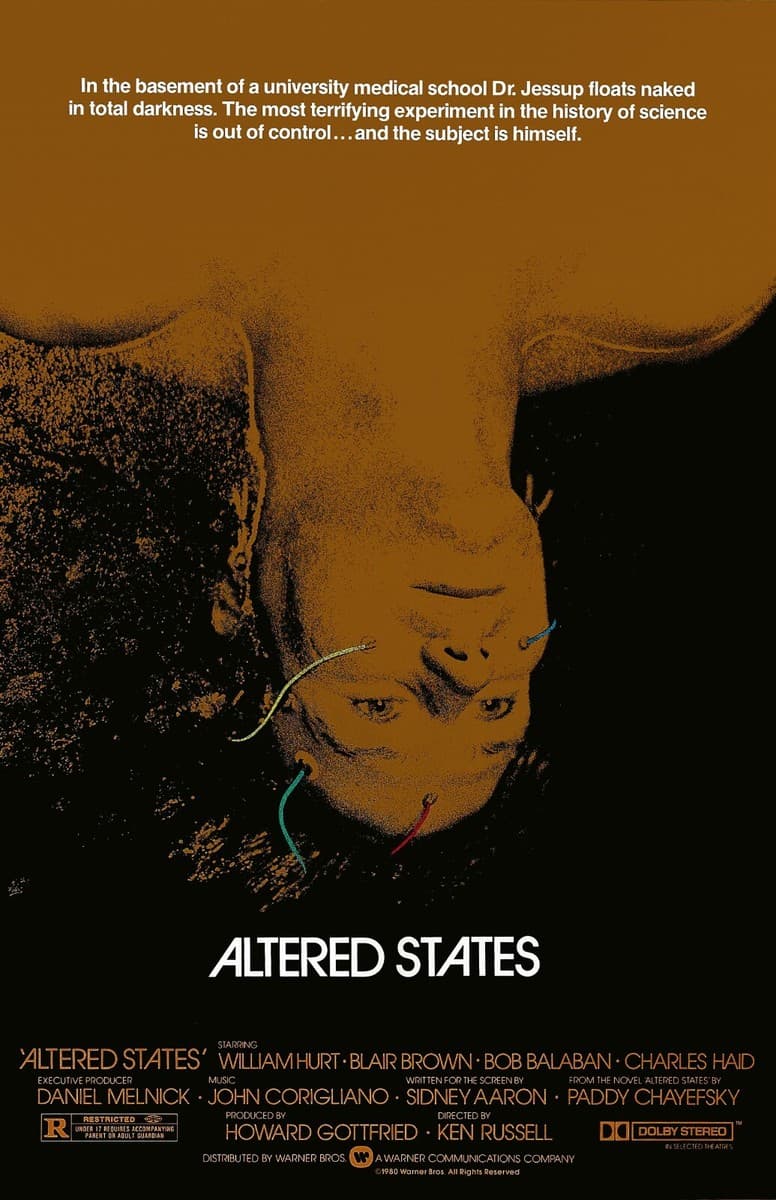
Ken Russell's Altered States is the sort of film that insists you look at one person very closely while everything around them dissolves. It's William Hurt's Eddie Jessup — a scientist who straps himself into an isolation tank, takes a powerful hallucinogen and proceeds to make both his marriage and his own body very complicated — that keeps the movie honest and oddly human.
THE MOVIE
Eddie Jessup is still the reason this movie works
If you remember Altered States at all, you'll likely remember transformations: a man changing in stages, the kind of physical regressions that feel startling and weirdly intimate. Those moments are not just spectacle; they are the outward pressure of Eddie Jessup's private project — a psycho-physiologist combining sensory-deprivation tank sessions with a potent hallucinogen to push at the edges of consciousness.
That experiment is the engine. Jessup's curiosity becomes a kind of personality; it eats into his marriage and his professional steadiness as his sessions produce altered subjective states and, crucially, progressive physical transformations that drive the drama. Ken Russell directs the chaos around that idea with a steady appetite for the strange, and William Hurt plays the man at the centre of it.
The film is doing more than body horror or science-fiction alarmism. At heart it's a small, loud argument about who we are when the things that define us — memory, biology, relationship — are unsettled. That tension between intimate human life and a rigourous, sometimes cruel scientific curiosity is what keeps Altered States worth talking about.
THE SETUP
The idea that sets Altered States in motion
The basic conceit is straightforward and sharp: a scientist tests the boundaries of consciousness by combining an isolation tank with an ethnographic psychoactive substance. It's the kind of premise that promises odd experiences and, with them, moral and physical consequences.
Jessup's self-experimentation isn't portrayed as a neat laboratory procedure. The film leans into sensory-deprivation sessions and hallucinatory episodes that depict regression and ancestral memory without patiently explaining every image. We get the mechanics — tank, drug, regression — and then the movie trusts the audience to feel the implications.
There are real-world references wired into the premise: the story draws explicitly on work about isolation tanks and the altered states they produce, and that context gives the experiments a slightly credible spine even as the film ventures into fantasy and horror.
Behind the visual and narrative choices, the production also reshaped its effects plan during pre‑production, eventually placing Bran Ferren in charge of the special visual effects. That practical reshaping underlines how the movie balanced ambitious ideas with the tricks it needed to show them.
THE CHARACTER
Why Eddie Jessup matters
Eddie Jessup is the film's constant. William Hurt's character is not merely an idea in a lab coat; he's someone whose appetite for knowledge becomes a personal faultline. The scientific curiosity that fuels his work starts to rub painfully against the ordinary responsibilities of marriage and profession.
The narrative tension is largely domestic in scale: there is a loving spouse who functions as the emotional counterpoint and a set of colleagues and friends who act as both sceptics and moral mirrors. Those relationships stop the film becoming a showreel of hallucinations and keep it anchored in human consequence.
Characters like Mason Parrish and Arthur Rosenberg exist to externalise risk and ethical worry — to give the audience faces to worry with, rather than at. Jessup's experiments are therefore more than self-indulgence; they become a choice that affects other people.
That personal stake is why the transformations matter. If the physical changes were divorced from family and friendship, the movie would be an effects exercise. Because Jessup's urge collides with people who love him and people who fear him, the film keeps its focus on what curiosity costs.
UNDER THE SURFACE
Altered States has more on its mind than the plot suggests
On its face, the film is a story about altered identity: what happens when a person’s sense of self is peeled back and remade, sometimes in ways that are literally physical. The regression sequences visualise that unmooring.
Closely related is ancestral memory and regression — the idea that consciousness can slip downwards into older patterns stored, somehow, in the body. The movie stages those possibilities without holding your hand, which sometimes feels disorienting and, at other times, audacious.
There is also a steady tug-of-war between science and intimacy. Jessup's laboratory method sits uneasily next to the domestic life he risks. The film makes you weigh the value of knowledge against the cost of pursuing it single-mindedly.
Finally, the story questions the limits of objective inquiry. Using tanks, drugs and self-experimentation, Altered States asks whether some aspects of human experience can be reduced to observation, or whether the act of observing changes the thing observed in a way science can't wholly contain.
PRACTICAL EFFECTS
The effects work that gives Altered States its physical personality
If the film's premise threatens to float off into giddy abstraction, practical effects drag it back into meat-and-bone territory. Makeup supervisor Dick Smith built multi-stage full-body prosthetic suits and specialised appliances to chart the protagonist's progressive regressions.
Smith's toolkit included inflatable air-bladder techniques and foam-latex stages that allowed the character's body to change in stages rather than in a single leap. Those hands-on methods give the transformations a tactile, uncomfortable believability.
The effects side was not static: an earlier plan was revised in pre-production and Bran Ferren stepped in to supervise the special visual effects. That reshaping of the effects team is part of how the film found a practical language for its more fantastical ideas.
On-location ethnographic footage shot in Creel, Mexico, and the staged use of live animals on set added an extra layer of grounded texture to the sequences meant to feel ancient or primal, reinforcing the film's claim to physical reality even when the imagery grows surreal.
PURE 80S
Altered States could not belong to any other decade
Released at the end of 1980, the film sits squarely where late‑1970s curiosity about consciousness met the early 1980s' appetite for genre daring. Its subject matter — isolation tanks, psychedelic-era anthropology and regression theory — reflects a particular cultural moment that Hollywood was willing to gamble on.
It also marks an interesting industry intersection: a prestige literary adaptation by Paddy Chayefsky made into an effects-driven studio film. That blend of seriousness and spectacle is very much of its time, when studios funded adult-oriented speculative pictures that demanded both ideas and cinema tricks.
The picture also launched careers: it contains the feature-film debuts of William Hurt and a very young Drew Barrymore, anchoring it in the field of 1980s actors who would go on to be familiar names.
Finally, Altered States sits beside other early‑1980s body‑horror/science‑fiction films that relied on pioneering practical makeup work; the era's technical ambitions helped shape a cluster of movies interested in the physical consequences of the mind.
THE LEGACY
Why Altered States still matters
There are a few concrete reasons the film keeps being revisited. Its score, composed by John Corigliano, earned an Academy Award nomination, and the picture also picked up a nomination for Best Sound — markers that the film's technical ambitions were recognised at the time.
Dick Smith's makeup work received awards attention too, including a Saturn Award tie for Best Make‑Up, and those prosthetic techniques are regularly referenced when people describe the movie's production methods.
Beyond awards, Altered States turns up in retrospectives and specialist programming as a distinctive 'head‑trip' picture; it has attracted modern home‑video and archival interest that treats its hallucination sequences as worth preserving and rewatching.
Archivists and reference platforms continue to list the film in discussions of cinematic hallucination and late‑20th‑century speculative work, which keeps it in circulation for new audiences curious about where practical effects and bold ideas met.
THE VERDICT
Does Altered States still hold up?
Yes — but with a rider. Altered States remains worth watching because it pairs a clear, unsettling idea with tangible practical work and a refusal to reduce its subject to neat answers. Eddie Jessup's experiments — isolation tank, psychoactive substance, regression — are the film's spine, and the progressive physical transformations ensure the stakes are never merely theoretical.
The film's themes — altered identity, ancestral memory, the friction between scientific curiosity and intimacy, and questions about how far objective inquiry can go — still feel provocative. They don't need modern gloss to read as interesting; they read as urgent choices a person makes about what to value and what to sacrifice.
There's also a sensory reason to watch: the prosthetic and practical effects chart a believable, physical path through the story's ideas, and the production's tangible choices keep the film tactile rather than purely hallucinatory. The technical nominations and awards the film received underline that those efforts were neither incidental nor decorative.
If you like movies that make you uncomfortable because they invite questions rather than hand you answers, then Altered States still pays its rent. It's a film about curiosity that remembers curiosity can devour the curious.
Share this movie
Keep watching
More movies from the 80s
1983
Christine
Obsession, adolescence and a car that won't let go.
Read our take →
1983
The Dead Zone
A quiet schoolteacher, an awful glimpse of tomorrow and the heavy work of knowing too much.
Read our take →
1982
Creepshow
Five nasty little tales, a comic-book wrapper and one perfectly awkward professor.
Read our take →