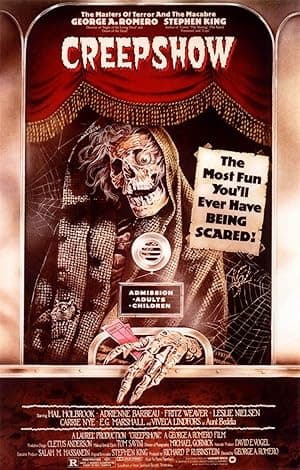
The setup
Creepshow greets you like a battered horror comic shoved through a blender — bright, nasty and oddly affectionate. George A. Romero directs, Stephen King supplies the material and the movie threads five sharply different stories through a kid’s horror comic, with Hal Holbrook’s Henry Northrup sitting uncomfortably at the heart of it all.
THE MOVIE
Henry Northrup is still the reason this movie works
Talk about Creepshow and you’ll get at least two immediate images: a kid with a horror comic and five short tales that read like pulp gone very wrong. The movie literally frames itself that way — a prologue and epilogue in which Billy discovers a horror comic whose pages introduce five discrete stories.
What keeps the whole thing from feeling scattershot is a recurring appetite — for payback, for spectacle and for that delicious comic-book tone. The segments have names you won’t mistake for high art: "Father’s Day," "The Lonesome Death of Jordy Verrill," "Something to Tide You Over," "The Crate" and "They’re Creeping Up on You!" — and each one is tuned to a particular kind of nasty delight.
Under Romero’s direction the film leans into those pleasures with gusto. And while the anthology format gives room for all sorts of madness, it’s Hal Holbrook’s Henry Northrup — a mild-mannered figure with secret weaknesses — who anchors the movie’s most memorable and surprisingly human nightmare.
THE SETUP
The idea that sets Creepshow in motion
At base Creepshow is an anthology stitched together by a comic book conceit: Billy finds a horror comic and each issue’s page introduces a new tale. That frame lets the movie hop registers — from rural contagion to domestic poison to a grotesque discovery in a crate.
Two of the segments are lifted straight from Stephen King’s short fiction, which gives the film a ready-made tone shift when it needs one. "The Crate" and "The Lonesome Death of Jordy Verrill" are explicitly adapted from King’s stories, so the film can lean on his knack for small-town dread and peculiar misfortune.
The setup works because it keeps things compact. Each story gets just enough time to set up a transgression and deliver the payback; the comic-book structure makes that quick turn-in tone feel intentional rather than rushed.
And because several instalments come from established short fiction, the picture has built-in architecture: a premise, a moral wobble and then the deliciously horrible consequences.
THE CHARACTER
Why Henry Northrup matters
Henry Northrup isn’t the loudest character in Creepshow. He’s quietly dreadful instead. The film slots him into "The Crate" as a mild-mannered professor whose private fantasies and moral weakness are central to what goes wrong.
That domestic rot — the petty cruelties, the small betrayals — is exactly the kind of material the anthology loves. Where some segments trade on external monsters, Henry’s story turns inward: family dysfunction is the pressure that finally cracks things open.
Because the movie moves quickly from tale to tale, casting familiar faces to establish a character fast was essential. Contemporary coverage noted that reviewers recognised this strategy: well-known actors appear to be playing slightly larger-than-life parts to match the comic-book tone.
In short, Henry matters because his conservatism and secret selfishness give the film a human-sized example of the recurring theme: when you push at the right place, everyone’s nightmare spills out.
UNDER THE SURFACE
Creepshow has more on its mind than the plot suggests
On the surface Creepshow is a string of lurid entertainments. Underneath, it keeps returning to a handful of ideas: retribution for moral transgressions, the violence simmering inside family life and a deliberate wink to comic-book luridness.
The "Father’s Day" segment, for example, centres family dysfunction and paternal authority, giving the anthology a domestic vice-like grip that contrasts with the more out-there stories.
That comic-book pastiche matters because it gives the moral outrage a form. The film dresses its punishments in panels and captions — broad, exaggerated, cartoonish — which lets the horrors read almost like cautionary fables.
And then there’s hubris and curiosity: whether it’s meddling with a crate or poking at an alien lump, characters’ curious, greedy or careless choices are often the sparks that set the violence in motion.
THE FILMMAKING
How Creepshow was put together
Romero didn’t try to stealthily disguise the movie as something it wasn’t. Contemporary reviews called out the film’s deliberately comic-book visual style, and that decision is everywhere: the staging and performances push slightly toward caricature so the short-form stories land as intended.
That blend of broad humour and splattery horror is the film’s organising principle: the craftsmanship isn’t trying to hide the seams but to celebrate them. The comic-book framing and animated interstitials act as connective tissue, turning five separate ideas into a single experience.
Casting known actors into clearly drawn parts was another practical move. When you’ve got maybe twenty minutes to sketch a character, recognisable faces are shorthand: they let the story move quickly from set-up to pay-off without getting bogged down.
So Creepshow’s filmmaking choices are less about subtlety and more about clarity of tone. It’s a movie built to resemble a comic — panels, captions, bold gestures — and it commits to that aesthetic across its segments.
PRACTICAL EFFECTS
The effects work that gives Creepshow its physical personality
Creepshow’s physical textures are a big part of its charm. Tom Savini supervised and executed the makeup and creature effects, including the apelike creature nicknamed "Fluffy" in "The Crate."
That wasn’t small-scale fiddling. AFI production notes record that the creature in "The Crate" required nearly five months to build; other sequences leaned on puppetry, prosthetics and complex mechanical setups.
And then there’s the memorable commitment to live animals: the segment "They’re Creeping Up on You!" used thousands of real cockroaches, with the production even consulting entomologists at the American Museum of Natural History to pick suitable species.
All of which makes the movie feel tactile. The effects aren’t glossed-over tricks; they’re physical presences that the camera and actors actually had to accommodate, and that gives the film its particular, slightly grubby personality.
PURE 80S
Creepshow could not belong to any other decade
Creepshow arrived in 1982 at a moment when anthologies and Stephen King adaptations were bubbling up in popular culture. That timing isn’t accidental; the early 80s loved short, sharp shocks and source material that already had a ready-made audience.
The movie also represents a particular 1980s habit: pairing a big-name novelist with a respected genre director. Stephen King’s presence as writer (and on-screen as Jordy Verrill in his own adapted segment) alongside George A. Romero is a neat example of that author-director collaboration becoming more visible in the era.
Because it was produced and released at that point in time, the film’s appetite for gore-meets-humour and its comic-book conceit felt of a piece with the decade’s genre experiments.
And the film’s afterlife — a theatrical sequel in 1987 and later franchise entries, including a 2019 television revival — shows how that early-80s formula had legs for follow-ups and revivals.
WATCHING IT NOW
What has aged — and what hasn't
Some parts of Creepshow are stubbornly effective. The film’s comic-book style — its broad gestures, blackly comic beats and brisk pacing — still reads as a deliberate choice rather than a period affectation. Contemporary reviewers flagged that mix of broad humour and gore, and it remains the film’s dominant personality.
The themes of family dysfunction and small domestic cruelties also translate. Stories that hinge on greed, infidelity or petty brutality tend to feel fairly timeless because they rely on human behaviour rather than fashion or topical references.
Where viewers might feel less forgiving is the anthology’s unevenness: some segments land harder than others. That’s part of the format’s bargain, and it’s a bargain modern audiences still accept if they’re in the mood for variety and practical shocks.
All told, Creepshow’s comic-book conceit and focus on moral comeuppance keep it watchable today; the film’s pleasures are precise enough to survive the years.
THE LEGACY
Why Creepshow still matters
Creepshow matters because it married two exportable things: Stephen King’s knack for short, unpleasant detours and Romero’s genre instincts, then wrapped both in a comic-book sensibility. That combination proved durable enough to spawn a sequel, later follow-ups and, decades on, a televised revival.
Beyond the franchise, the film’s mix of gore and black comedy — and its willingness to dress moral comeuppance in pulpy visuals — left a clear mark on how anthologies could be presented. The comic-book framing and cartoonish punishments are often referenced in summaries of 1980s horror anthologies.
It’s also worth noting that the movie’s practical approach to effects and its decision to cast recognisable actors in bold, quickly established parts made the anthology feel professionally appointed rather than amateurish.
So whether you trace the lineage through sequels or simply remember the texture of those short shocks, Creepshow keeps turning up in conversations about how to do anthology horror with style and a wink.
THE VERDICT
Does Creepshow still hold up?
Yes — if you understand what you’re signing up for. Creepshow is built as a 120-minute comic: a boy finds a horror comic and its five tales unfold in quick, punchy instalments. The film’s DNA is short-form shock, black comedy and moral payback.
If you like your horror boxed and labelled — greed, infidelity, cruelty leading to grotesque retribution — Creepshow delivers. The framing device and animated interstitials deliberately evoke EC-style horror comics, and the movie keeps that aesthetic consistent across its segments.
Practical craft helps. Tom Savini’s makeup and creature work (including the apelike monster in "The Crate") and the astonishing commitment to using thousands of live cockroaches on set give the film a physicality that still reads as impressive and unflinching.
So watch it for the pleasures it aims to offer: mordant humour, moral comeuppance and hands-on effects. If you want subtlety, look elsewhere. If you want a nasty, clever anthology that knows exactly what it is, Creepshow is still worth your time.
Share this movie
Keep watching
More movies from the 80s
1985
Day of the Dead
A bunker drama with zombies, a scientist who won a festival, and a soldier who won't listen.
Read our take →
1985
Lifeforce
Lifeforce: mortality and freedom, and why this 1985 movie still matters.
Read our take →
1984
Night of the Comet
Sisters, malls and a comet — Night of the Comet is a B-movie that learned how to be fun and oddly wise about survival.
Read our take →