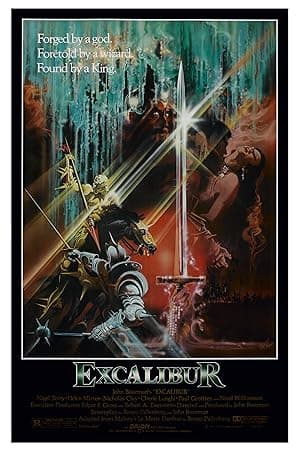
The setup
Excalibur is the kind of film that wants you to feel the crown more than admire it. John Boorman’s 1981 retelling pushes Arthur from boyhood into kingship and hangs the whole thing on ritual, prophecy and a sword that doubles as a political argument. If you’re coming back to it (or meeting it for the first time), the movie still feels like a curious, muscular take on legend rather than a polite museum piece.
THE MOVIE
King Arthur (Arthur Pendragon) is still the reason this movie works
There’s a simple engine at the heart of Excalibur: a story about a boy who becomes a ruler, and the rituals that convince everyone to call him king. Boorman’s film isn’t content with a throne as an object; it treats the making of a monarch as an event — myth and ritual actively doing political work.
A prologue literally files the story under ‘The Dark Ages’ and sets up Merlin, the sword and the coming together of a divided land. The film then tracks Arthur from adolescence into adulthood, making his claim to legitimacy depend as much on ceremony and omen as it does on blood or battle.
That’s why Nigel Terry’s Arthur sits at the centre: Excalibur’s scenes of coronation, combat and counsel are all refracted through the question of who can truly unite the realm. It’s an old legend, but Boorman stages it as a brute, theatrical attempt to make legitimacy visible.
THE SETUP
The idea that sets Excalibur in motion
Excalibur opens with intent: it wants you to know this is a tale about founding and assent. The written prologue places everything in a mythic past where Merlin and the supernatural are not curiosities but political tools.
From there, Merlin and the sword act as structural devices. They are the means by which Arthur is recognised and tied to the land — the film treats Excalibur itself as a kind of legal instrument that translates destiny into rule.
That arrangement keeps the plot moving without getting bogged down in genealogies. The film condenses familiar episodes and uses the magical moments to explain why men will follow a king rather than simply showing them do so.
It’s economical storytelling: ritual provides motive, magic provides authority, and Arthur is the figure those forces converge upon.
THE CHARACTER
Why King Arthur (Arthur Pendragon) matters
Arthur is the film’s measuring stick. He’s not just a recipient of legend; the movie puts him through stages — adolescence to adulthood — so we can see how legitimacy is manufactured and tested over time.
That trajectory matters because it makes his kingship feel earned within the film’s logic. His authority is repeatedly tied back to Excalibur and the broader ideal of uniting a splintered realm, rather than presented as a simple inheritance.
Boorman’s choice to follow Arthur across years gives the movie a curious intimacy: the grand rituals still have personal consequences. The crown feels like something that is made over multiple ceremonies, mistakes and decisions.
All of which is why Nigel Terry’s casting matters within the film’s architecture — Arthur isn’t a myth floating above the action, he’s the hinge on which the film’s argument about political legitimacy swings.
THE PERFORMANCE
Why Nicol Williamson's performance matters
Merlin is a living fulcrum in Excalibur: a magician, strategist and the technician of fate. The part asks for a presence that can be both catalytic and uncanny.
Contemporary reviewers singled out Nicol Williamson’s take on the role, which helped fix Merlin in the audience’s mind as a force shaping events rather than a mere plot device.
Within the movie’s economy, Merlin does heavy lifting: he engineers moments, nudges the story and creates the circumstances that make Arthur’s ascent believable. Williamson’s portrayal was the element critics returned to when discussing how effectively those choices worked on screen.
The result is a Merlin who reads as active author and moral complication — it’s not just about magic, but about the taste and cost of using it to make kings.
UNDER THE SURFACE
Excalibur has more on its mind than the plot suggests
At face value Excalibur is an adventure about swords and succession. Under the skin it’s asking how stories and ceremonies make power legitimate. Myth and ritual aren’t window dressing here; they’re the mechanisms that create political consent.
That concern with legitimacy and kingship threads through the film: the crown isn’t merely a prize, it’s a performance that the realm must accept. Boorman stages that acceptance as something fragile and constructed.
Betrayal and desire complicate the political question. Personal lusts and betrayals don’t just wreck households — in this telling they are the pressure points that destabilise a political order built on belief and ceremony.
And beneath all of it is the notion of quest and destiny: characters are moved by prophecy and calling, but the film keeps reminding us that destiny needs allies — rituals, witnesses and weapons — to become history.
THE FILMMAKING
How Excalibur was put together
Excalibur wears its craft on its sleeve. The film’s look — the way scenes sit and the way moments are composed — was shaped by Alex Thomson behind the camera, whose cinematography earned the film an Academy Award nomination.
That nomination isn’t just a trophy line: it signals that the film’s photographic choices were central to how Boorman told a myth on screen. The images had to carry ritual weight and the sense of history the story demands.
Boorman directed, co-wrote and produced the piece, shaping its rhythms and the scale of its set-pieces. The result is a film that feels deliberately staged: theatrical at times, intimate at others.
All of which means that the movie’s identity is as much visual and structural as it is narrative — how a scene is shot here often does the work of exposition or mood in place of explanation.
PRACTICAL EFFECTS
The effects work that gives Excalibur its physical personality
Excalibur credited a multi-person practical and optical effects team, along with model making and special photographic effects — the production didn’t pretend the magic was all in the script.
Stunts and combat were handled with a professional stunt squad; William Hobbs arranged fight training, and both cast and horses trained for an extended period to sell the movie’s combat sequences.
Those credits matter because the film frequently switches between spectacle and ritual: when a supernatural moment lands, it needs the physical production around it to keep the fantasy grounded.
Put simply, the movie’s physical workmanship — from models and opticals to choreographed battle — is part of how Boorman convinces an audience to take his version of Arthurian myth seriously.
PURE 80S
Excalibur could not belong to any other decade
Excalibur arrived in 1981 as a relatively high-profile attempt to bring large-scale fantasy to cinemas — it belongs squarely to the era’s handful of serious, theatrical myth films rather than the cottage-industry fantasy that followed later in the decade.
That timing matters because the movie sits before the flood of later fantasy franchises; it felt like a film-level gamble on myth and spectacle at a moment when studios were ready to try something outsized.
Boorman’s stylised visual approach and the use of an original score (with recognised classical extracts woven in) place Excalibur alongside other early-1980s attempts to realise myth with cinematic seriousness.
Its Cannes prize for Best Artistic Contribution the same year underlines how the film was read then: an artistic statement as much as a medieval yarn.
THE LEGACY
Why Excalibur still matters
Excalibur’s legacy is not a single line of influence but a handful of durable acknowledgements. It won the Cannes prize for Best Artistic Contribution in 1981, which reinforced its status as a film with serious artistic intent.
The movie’s cinematography — Alex Thomson’s work — earned an Academy Award nomination, signalling that its visuals were taken seriously by the industry as well as audiences.
Critics and filmmakers continue to reference Excalibur when discussing cinematic treatments of Arthurian legend; it’s often brought up as a visually distinctive adaptation that reworks Malory rather than slavishly reproducing him.
There were even talks of a remake years later, a sign that the film’s particular take on legend keeps returning to the industry’s imagination, even if later projects did not reach production.
THE VERDICT
Does Excalibur still hold up?
Yes — if you meet the film on its own terms. Excalibur compresses broad swathes of Malory into a single continuous narrative and makes recurring choices: it alternates military action with ritual and myth so the audience understands rule as performance as well as outcome.
If you’re interested in how legend can be made into law, the film’s structure and the way Merlin and Excalibur are used as story mechanics still reward attention: they don’t merely explain Arthur’s rise, they create the conditions that let a kingdom accept him.
The movie is not a gentle primer; it asks you to accept condensed episodes and theatrical set-pieces. But where that works best — in the scenes that stage coronation, the Lady of the Lake or magical interventions — it pays off because the political stakes feel tangible.
So watch it for the argument as much as the spectacle. Boorman turned Malory into a film about how a nation invents its king, and for anyone curious about kingship, ritual and the cost of making myth useful, Excalibur is still worth the evening.
Share this movie
Keep watching
More movies from the 80s
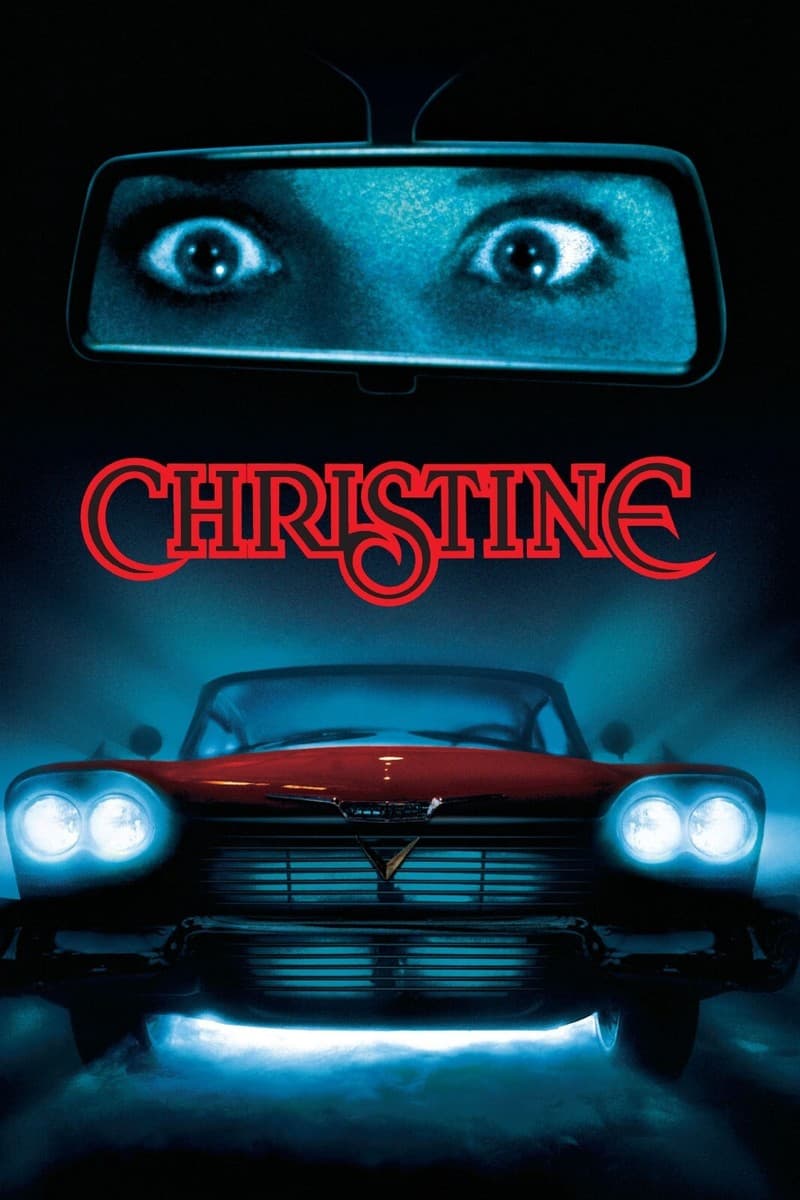
1983
Christine
Obsession, adolescence and a car that won't let go.
Read our take →
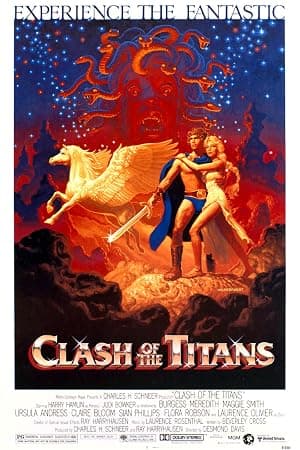
1981
Clash of the Titans
A labour of gods, monsters and one man who won't be pushed around.
Read our take →
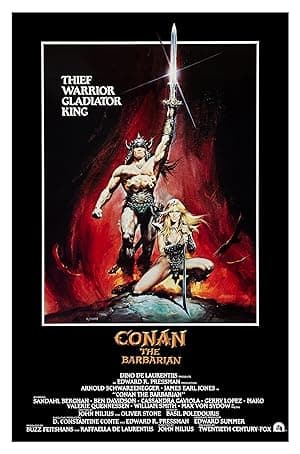
1982
Conan the Barbarian
A musclebound quest that talks about steel, fate and how to be remade by violence.
Read our take →