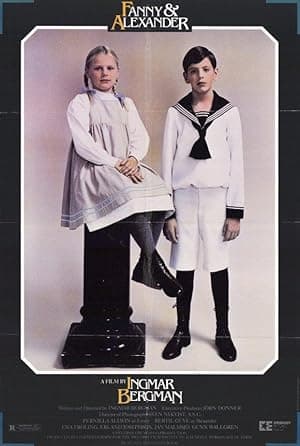
Fanny and Alexander
A family drama where theatre, childhood fancy and a stubborn bishop collide — and Alexander refuses to be small.
The setup
If you remember one thing from Fanny and Alexander, let it be a boy who treats imagination like a weapon. Ingmar Bergman’s warm, sprawling family chronicle keeps being returned to because of that refusal: Alexander Ekdahl won’t sit down and be respectable. The result is a movie that’s as much about how families survive as it is about how they tell stories to themselves.
THE MOVIE
Alexander Ekdahl is still the reason this movie works
Call it a family epic if you must, but the clearest way into Fanny and Alexander is through a child who simply will not be domesticated. Alexander Ekdahl’s imagination turns the film’s domestic fights into something alive and, often, dangerous to the decorum the adults prize.
Bergman lays out the battlefield neatly: an extended theatrical clan used to warmth and invention, and the cold, austere household that arrives after the boys’ father dies and their mother remarries a strict bishop. The collision gives the story shape — and gives Alexander a proper antagonist in the form of an unforgiving household creed.
That crunch — family pleasures and theatricality against authoritarian religion — is why the film keeps being watched and argued about. Bergman wrote the screenplay as a partly autobiographical chronicle, and the movie’s appetite for both memory and invention comes from that personal impulse.
THE SETUP
The idea that sets Fanny and Alexander in motion
At its simplest the film charts a family across a bitter hinge: the death of Oscar Ekdahl and Emilie’s subsequent remarriage. That legal and social turn changes where the children live and who has power over them.
What follows isn’t just courtroom or custody drama. The household the bishop imposes brings a disciplinarian, punitive religiosity that clashes directly with the Ekdahls’ theatrical, generous world. Alexander, in particular, finds himself at odds with rules he can’t accept.
Bergman keeps the rails of realism in place — marriage law, social pressure, custody disputes — but he doesn’t stop there. Fantastical material threads through the story: ghostly visitations, puppet motifs and sequences of pure imagination sit beside the more mundane mechanics of law and family.
That mixture of domestic reality and magic-realist flash is what lets the movie feel both like a court case and like a remembered childhood: part social history, part invented myth.
THE CHARACTER
Why Alexander Ekdahl matters
Bertil Guve plays the boy at the movie’s centre, but what matters more than casting is what the character refuses to surrender: imaginative life. Alexander is not a passive victim of adult decisions; he tells stories, makes meaning and, crucially, resists being reshaped into someone smaller.
His fantasies are not decorative. They are tools and shields — ways of asserting identity in a household that wants obedience. That direct conflict between a child’s appetite for wonder and a stepfather’s insistence on discipline is the film’s most human tug-of-war.
Fanny, his sister, is part companion and part co-conspirator. The sibling bond is where the film finds most of its childhood perspective. Their shared view of the world keeps the familial warmth alive even when adult choices threaten it.
And there’s Helena, the grandmother: a living connection to theatre, memory and indulgence. She acts as a custodian of the family’s imaginative life — a reminder that the Ekdahls’ identity is made of stories as much as obligations.
UNDER THE SURFACE
Fanny and Alexander has more on its mind than the plot suggests
Under the surface it’s a family story about power: who gets to decide how a household is run, and what it means to win custody of a child’s imagination. Domestic conflict isn’t window dressing here — it’s the engine.
Childhood and imagination are treated with seriousness. The film asks whether a child’s inner life can survive institutional pressure, and whether adults owe children more than mere obedience.
There’s also a cultural fight between art and authoritarian religion. The Ekdahl household’s theatricality stands for generosity, plurality and the messy business of living; the bishop’s domain counters with rigid moral order and punitive rules.
Finally, Bergman frames the whole thing through memory: the screenplay reads like a chronicle of family recollection, the blend of the real and the uncanny reflecting how we remember childhood — as both fact and fable.
THE FILMMAKING
How Fanny and Alexander was put together
Part of why the film feels lived-in is the craft behind it. Sven Nykvist handled the photography and the look is widely noted for its warm, richly coloured interiors and carefully composed frames — the sort of cinematography that makes rooms feel like characters.
Anna Asp’s production design gives those rooms a dense, period authenticity; there’s a sense of accumulated objects and theatrical backdrops that tell you who this family thinks it is, without needing a line of dialogue.
On the nuts-and-bolts side, Sylvia Ingemarsson is the credited editor and the production used Eastman Color film stock in a 1.66:1 ratio — practical choices that shape how images sit on screen and how the story breathes.
Those crafts were recognised at awards level: the film picked up top technical honours that underline how much of its pleasure comes from the way it’s been put together.
PRACTICAL EFFECTS
The effects work that gives Fanny and Alexander its physical personality
Bergman’s film leans on old-stage tricks as much as on psychological suggestion. Practical effects and stagecraft — including puppets and model/puppet work — are credited in the production and woven into the film’s uncanny moments.
That tangible approach keeps the supernatural and magical touches tactile rather than merely digital or abstract. When an effect happens, you can still feel the hand that made it.
There are also practical lighting and exorcism-type effects handled by the film’s practical-effects crew, which gives certain scenes an immediate, theatrical intensity.
Those techniques help the movie sit between memory and stage-play: part story, part performance, and always physically present.
PURE 80S
Fanny and Alexander could not belong to any other decade
It’s easy to think of Bergman as timeless, but the film is also a product of its moment. Released in 1982, it was one of the most ambitious and costly Swedish productions of the early 1980s — an international project that carried weight beyond its national cinema.
The financing and scope mattered: it was co-produced across Sweden, France and West Germany, which let Bergman assemble a very large cast and crew and treat the story with a scale not always available in earlier decades.
Principal photography ran from late 1981 into 1982, and Bergman prepared both a theatrical cut and a much longer television version — a production strategy that reflects the period’s appetite for large-scale auteur-driven projects that could live in cinemas and on the small screen.
That ambition — the scale, the multiple versions — is part of what marks it as an early-80s phenomenon: a director expanding his canvas when the industry could afford to follow him.
WATCHING IT NOW
What has aged — and what hasn't
Certain elements still pop: modern restorations and home‑video releases regularly point to the photography and the production design as particular strengths — the film’s rooms and colour feel as resonant now as they did on first release.
The central domestic conflict also retains punch. The argument between an imaginative, indulgent household and an authoritarian one is a human dilemma that isn’t locked to a single decade.
Because Bergman conceived the screenplay as a semi‑autobiographical chronicle, the film’s mixture of memory and invention keeps it emotionally specific rather than generic — people still respond to that texture of recalling childhood in both fact and fantasy.
And scale still impresses: the production lists a very large cast and company of extras, which helps the world feel populous and lived-in rather than stage-bound.
THE LEGACY
Why Fanny and Alexander still matters
The film’s craft received formal recognition: at the Academy Awards it took home Best Foreign Language Film and several technical Oscars for cinematography, art direction and costume design — a practical nod to the work’s material richness.
Its afterlife hasn’t been limited to awards. It regularly appears in retrospectives, has been the subject of museum exhibitions and stage adaptations, and is included in major home-video restorations — all signs institutions keep returning to its production design and costumes.
Critics and filmmakers continue to cite it, and major restorations by home‑video curators underline a continued interest in the film as a reference point for craft and storytelling.
Put simply: the movie keeps circulating because it supplies both a rich object of design and a complicated family story that invites ongoing discussion.
THE VERDICT
Does Fanny and Alexander still hold up?
Yes — for viewers who want a film where family politics are treated as richly as plot mechanics. The film’s central contest, where children are placed under a strict domestic regime and a boy’s imagination resists, still carries emotional weight.
The movie’s architecture helps: Bergman stages the warm Ekdahl household against the austere Vergérus house, and that opposition drives both story and argument about what family life should allow or deny.
The mix of the fantastical — ghosts, puppets, flights of fancy — with the blunt realities of law and custody keeps the film alive in a way a purely realist chronicle might not. If you enjoy stories that move between remembered wonder and social consequence, this one rewards patience.
Practical note: Bergman prepared two versions. The theatrical cut is a long, self-contained experience; the extended television version restores episodes and character detail for readers who want to live in the world longer. Either way, Alexander and Fanny’s view of the world remains the film’s beating heart.
Share this movie
Keep watching
More movies from the 80s

1985
Rocky IV
Rocky IV: courage and mortality and lifespan, and why this 1985 movie still matters.
Read our take →
1987
Less Than Zero
Less Than Zero: family and friendship, and why this 1987 movie still matters.
Read our take →
1983
A Christmas Story
Nine years old, a single-minded wish, and a narrator who never lets you forget it.
Read our take →