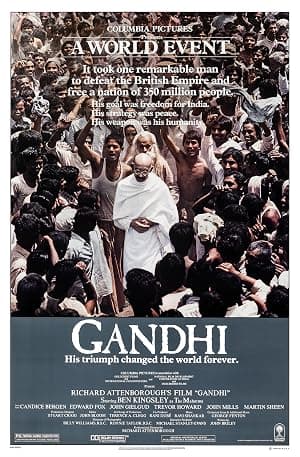
Gandhi
A long, careful movie about a very particular kind of courage: the refusal to meet violence with violence.
The setup
Richard Attenborough’s Gandhi begins at the end — the assassination and funeral — and then spends three hours asking how one man’s choices reshaped a nation. It’s not a ticker-tape life story so much as a study in moral methods: satyagraha, fasting and mass civil disobedience put ideas into the world and watch history respond. Revisit it because the film still stages a debate we keep having about power, principle and politics.
THE MOVIE
Mahatma (Mohandas K.) Gandhi is still the reason this movie works
You remember the image before the sequence: the funeral and the shock that opens the film. Attenborough starts with the end deliberately, then folds the rest of the picture back into itself in long flashbacks that cover roughly five decades of Gandhi’s public life.
That structural choice matters because the film isn’t after a tidy political narrative so much as the logic of a method. From his early work in South Africa to the Salt March and mass civil disobedience in India, the film keeps returning to the same question: what happens when a leader insists on nonviolence as both tactic and creed?
At the centre of this machine is Gandhi himself — Ben Kingsley’s on-screen presence anchors the film, and Attenborough sets the camera and the sprawling staging to follow where that moral authority leads. The result is a long, deliberate biographical drama that uses scale and patience to make an argument.
THE SETUP
The idea that sets Gandhi in motion
At its simplest, the film sets up a central operating idea: Gandhi’s methods — non-violence, fasting, organised civil disobedience — are the tools the story uses to move politics. Events are chosen and ordered to show how those tools work in practice, from colonial confrontations to mass movements.
That’s why the film keeps returning to the Salt March and the South Africa years: they’re not decorative episodes but demonstrations of a technique for winning political leverage without matching force for force.
Attenborough and John Briley don’t attempt a forensic, blow‑by‑blow political history. Instead the movie arranges episodes around Gandhi’s moral choices, so the drama is less about strictly causal politics and more about the friction between principle and power.
The result is a chronological sweep that still feels organised around a single question — how a committed moral practice actually translates into political change — rather than a conventional rise‑and‑fall plot.
THE CHARACTER
Why Mahatma (Mohandas K.) Gandhi matters
The film rests on one stubborn dramatic proposition: Gandhi’s personal discipline and moral rigour are not incidental; they are what shape events. His choices — public fasts, mass marches, the refusal to retaliate — are treated as instruments rather than mystical traits.
Because the screenplay keeps bringing us back to those methods, Gandhi becomes memorable as a problem‑solver who insists on a particular kind of consistency. He’s the character who forces other figures, from British officials to Indian politicians, to confront the consequences of force versus principle.
That focus also gives the smaller, private moments weight. Kasturba appears throughout as a continuing presence whose life is entwined with Gandhi’s public vocation; we notice how personal loyalties and public duties collide.
And the film makes political figures — Nehru among them — into interlocutors rather than caricatures, so Gandhi’s leadership is shown in conversation, not in isolation.
THE PERFORMANCE
Why Ben Kingsley's performance matters
Contemporary recognition makes a straightforward claim: Ben Kingsley’s portrayal of Gandhi was the film’s central public achievement. That acclaim culminated in the Academy Award for Best Actor.
Which is to say: the film’s argument about Gandhi lives or dies partly through its casting and portrayal. Critics of the day singled out Kingsley as the element that allowed the movie to carry its thematic weight.
So whether you watch for history, politics or character study, Kingsley’s role is the hinge the rest of the film swings from — the performance is the point at which biography becomes an attempt at moral theatre.
UNDER THE SURFACE
Gandhi has more on its mind than the plot suggests
On the face of it, Gandhi is a political biography. Under the surface, it’s wrestling with a clutch of ideas that keep bumping into each other: colonialism, the ethical dilemmas of national self‑rule, religious pluralism and the hard choices of leadership.
Nonviolence and civil disobedience are the film’s practical experiments. The scenes of mass action are not just spectacle — they’re staged tests of whether principle can be turned into power without bloodshed.
That ethical testing becomes painfully visible when the narrative confronts communal violence and partition. The movie doesn’t shy from the moral complexity of those moments; they ask whether moral consistency is always compatible with the messy pressures of nationalism and survival.
Taken together, the themes give the film a sustained seriousness: it’s less about celebrating a single hero than about putting political methods and moral claims to the test.
THE FILMMAKING
How Gandhi was put together
The film’s look and scale are deliberate choices. Cinematography credits go to Billy Williams and Ronnie Taylor, and the visual approach leans on broad, classical framing that lets large crowd compositions breathe.
Production design, led by Stuart Craig with a substantial art department, was used to give the story its sense of period across decades and geographies rather than to dazzle with novelty.
Editing too is part of the plan: John Bloom and Attenborough favour an episodic, classical editorial rhythm that sustains the multi‑decade sweep without collapsing it into noise.
Put simply: the filmmaking choices — framing, design and editing — are there to keep the film readable as a long, argument‑driven biography rather than an impressionistic portrait.
PRACTICAL EFFECTS
The effects work that gives Gandhi its physical personality
Gandhi’s scale is a practical matter. Several sequences were staged with very large crowds on location in India; the funeral on Rajpath reportedly involved some 300,000 extras and stands as a production feat in contemporary accounts.
That scale didn’t happen by accident. The production relied on extensive second‑unit work and on the coordination of huge numbers of people, with a sizeable unit and stunt staff attached to the shoots.
Those logistical choices are part of the film’s personality: the sense of public magnitude is a practical achievement as much as an aesthetic one.
PURE 80S
Gandhi could not belong to any other decade
Released in 1982, Gandhi arrived at a moment when British cinema was renewing its attention to Indian subjects, and it positioned itself as a major Anglo‑Indian collaboration rather than a small art‑house project.
The film’s scale, subject and awards trajectory made it one of the most prominent such collaborations of the early 1980s — an example of the decade’s appetite for large‑scale historical biopics with international ambitions.
Richard Attenborough’s approach — a sprawling, multi‑decade epic built around a famous political life — is very much of that period: movies that wanted both prestige and a global reach.
In short: the film’s size and its presence in awards conversation are part of what ties it to the early 80s moment.
THE LEGACY
Why Gandhi still matters
There’s an obvious, recorded reason the film stays in cultural conversation: it was an awards heavyweight, winning eight Academy Awards including Best Picture, Best Director and Best Actor.
Beyond trophies, the film’s production scale — the funeral sequence with hundreds of thousands of extras — is repeatedly noted in production histories as a landmark logistical achievement.
Those two facts helped the movie broaden international attention for large‑scale historical biopics and did a great deal to establish Ben Kingsley’s international profile.
So Gandhi’s legacy is both cinematic and practical: it changed perceptions of what a British–Indian co‑production could attempt, and it did so on a very public awards stage.
THE VERDICT
Does Gandhi still hold up?
Yes — for a certain, specific reason. If you want a film that insists on taking nonviolence, civil disobedience and the ethics of leadership seriously, Gandhi still delivers. It stages those ideas repeatedly — the Salt March, the South Africa episodes, and the confrontations with colonial officials like General Dyer — so you leave with a clear sense of the methods and their consequences.
The movie is long (commonly 188 minutes), ceremonious and organised around Gandhi’s moral choices rather than a single political causal chain. That means it rewards patience: it isn’t streamlined for modern short attention spans, but it is coherent in the way it keeps returning to its central argument.
Ben Kingsley’s central role anchors the film’s claim — the performance was recognised with an Academy Award and contemporary commentary singled it out as a central achievement — while Rohini Hattangadi’s presence as Kasturba provides a persistent, humane counterpoint to the public project. Nehru and other figures are dramatized in ways that show tension and deference without dissolving them into simple types.
If you come to Gandhi wanting spectacle, you’ll find scale; if you come for interrogation of method, you’ll find a film that keeps pushing the same question. Watch it for its patient seriousness — and for the reminder that a political method can be dramatised as steadily as any action sequence. It still matters because it refuses to let its central idea be background noise.
Share this movie
Keep watching
More movies from the 80s
1982
An Officer and a Gentleman
A hard-edged coming-of-age wrapped in military drill, unexpected tenderness and one stubborn loner.
Read our take →
1982
Annie
Annie: family and freedom, and why this 1982 movie still matters.
Read our take →
1982
Blade Runner
Four engineered years, a handful of memories and a detective who isn’t sure he wants to do his job.
Read our take →