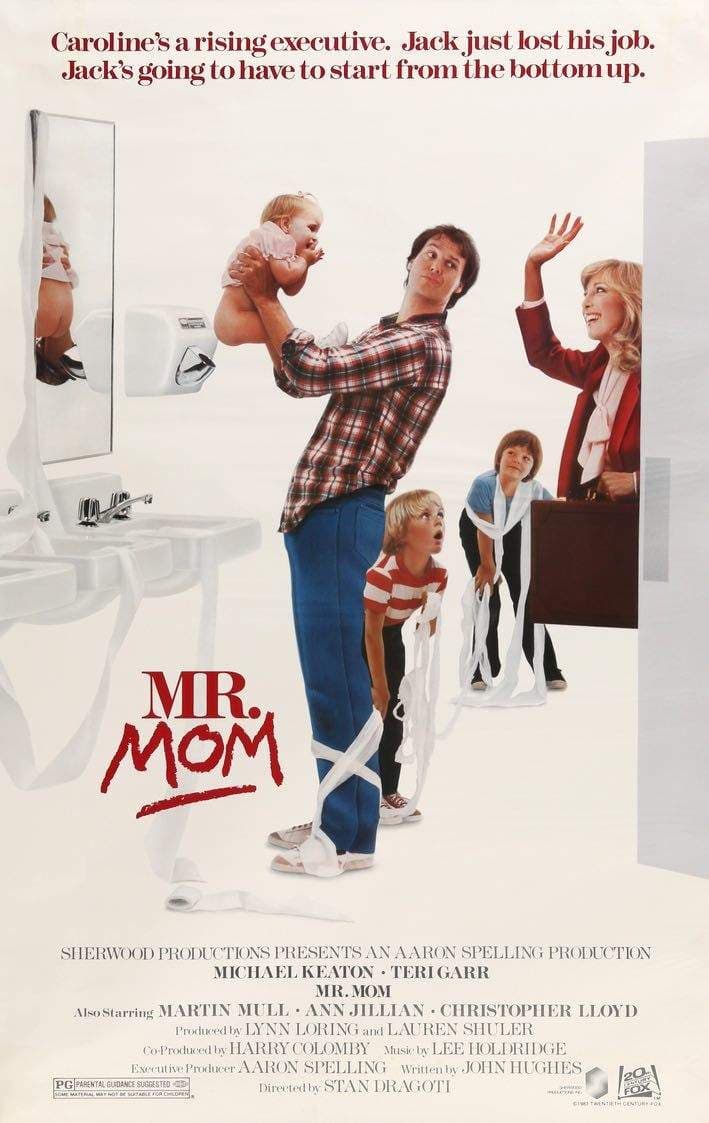
The setup
Mr. Mom arrived in 1983, directed by Stan Dragoti. Jack Butler lives with his wife, Caroline, and their children Alex, Kenny, and Megan, in a Detroit suburb. Decades later, it is worth looking at why the film still connects with audiences.
THE MOVIE
Jack Butler is still the reason this movie works
Mr. Mom was released in 1983 and directed by Stan Dragoti. Rather than simply retelling the plot, the film is worth revisiting for the characters, conflicts and ideas that give its story its identity.
Family, Consumerism and Home and safety emerge through what the characters face and the choices they make, giving the story more to explore beyond its immediate plot. Jack Butler, Caroline Butler and Alex Butler do not begin the film seeing one another clearly, and watching those first impressions break down is a big part of why Mr. Mom still works.
THE SETUP
The idea that sets Mr. Mom in motion
Jack Butler lives with his wife, Caroline, and their children Alex, Kenny, and Megan, in a Detroit suburb.
During the early-1980s recession, Jack and his friends Larry and Stan lose their engineering jobs at the Ford Motor Company. That detail matters because it shapes the way the characters initially see one another.
Caroline, having been a housewife for years, uses her college education and experience working in advertising to re-enter the workforce, leaving Jack to deal with the new and bewildering responsibilities of a stay-at-home dad. From there, the film can concentrate less on explaining the setup and more on what happens between the people inside it.
Jack discovers childcare and house maintenance involve a complex juggling act, and his initial struggles in daily errands gain the attention and company of other neighborhood housewives.
Eventually, he hits his stride and although somewhat distracted by the flirtatious Joan (a neighbor and friend of Caroline's), he begins to feel confined by suburban domestic life.
Simultaneously, he feels threatened by Caroline's responsibilities and work-life as a fast-climbing ad executive.
Meanwhile, Caroline contends with challenges in the workforce: her maternal and housekeeping instincts jeopardize her position as a sophisticated executive, and her boss Ron Richardson is intent on seducing her.
During a pitch to a hard-to-please client, Caroline's insight as a budget-conscious housewife proves invaluable.
The client's president wants her to fly to Los Angeles to help shoot a commercial.
UNDER THE SURFACE
Mr. Mom has more on its mind than the plot suggests
Mr. Mom has more on its mind than the basic setup suggests. family sits close to the centre of the film, but it is explored through the characters rather than treated like a lesson.
consumerism matters just as much. The film keeps challenging the assumptions its characters make about one another, which is where much of its emotional weight comes from.
There is also plenty here about the safety of home and friendship. Those ideas overlap rather than sitting in separate boxes, which helps the movie feel like a story about people rather than a checklist of themes.
PURE 80S
Mr. Mom could not belong to any other decade
Mr. Mom could hardly be separated from the decade that produced it. Released in 1983, it carries the attitudes, style and filmmaking rhythms of the 1980s without needing to announce them.
It also sits comfortably within the era's drama and comedy filmmaking, even if the movie itself is more interesting than any single genre label suggests. That is part of why it still appears in conversations about 1980s movies and 1980s drama movies. The film has become tied not only to its own story but to the wider memory of what 1980s movies felt like.
WATCHING IT NOW
What has aged — and what hasn't
Watching Mr. Mom now means seeing both what has lasted and what unmistakably belongs to 1983.
What still works best is the human material. Ideas around family, consumerism and the safety of home have not stopped being relevant simply because the clothes, language and cultural references belong to another era.
Some moments inevitably land differently for a modern audience. Revisiting an older film properly means enjoying what still works without pretending every choice has aged equally well.
THE LEGACY
Why Mr. Mom still matters
A large part of that staying power comes from the characters. Jack Butler, Caroline Butler and Alex Butler are still useful shorthand for the personalities and pressures the film explores.
Mr. Mom has lasted because people continue to recognise something in it. Nostalgia helps, but nostalgia alone does not keep a movie in the conversation for decades.
THE VERDICT
Does Mr. Mom still hold up?
So, does Mr. Mom still hold up? Yes — although watching a film from 1983 honestly means accepting that not every moment will land exactly as it once did.
The film still has something recognisable to say about family, consumerism and home and safety, and its characters stop those ideas from feeling abstract. Mr. Mom remains worth revisiting because characters such as Jack Butler, Caroline Butler, Alex Butler, Kenny Butler and Megan Butler still feel like people rather than labels once the film gets underneath the stereotypes.
Share this movie
Keep watching
More movies from the 80s

1983
Educating Rita
A working‑class hairdresser, an exasperated tutor and a lesson that changes both of them.
Read our take →
1983
Local Hero
Local Hero: corporate power and greed, and why this 1983 movie still matters.
Read our take →
1983
Risky Business
A suburban teenager, a one‑night business and the day ambition learned to look dangerous.
Read our take →