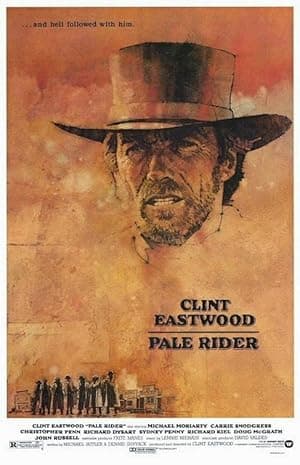
Pale Rider
A pale horse, a stranger and a town asked to stand or sell — Eastwood's late-Western handshake with Shane.
The setup
Pale Rider keeps turning up in conversation because it has a simple, stubborn centre: a man on a pale horse who arrives when a small mining community is being squeezed and quietly changes everything. It’s Clint Eastwood’s take on the lone-stranger protector, wrapped in a deliberate question about whether he’s flesh and blood or something more. For anyone deciding whether to revisit it, that tug-of-war — community against corporate muscle, mystery against the obvious — is where the film earns its keep.
THE MOVIE
Preacher is still the reason this movie works
LaHood is a small, loosely organised band of gold prospectors under pressure — a classic David-and-Goliath setup where the Goliath just happens to have hired deputies. That squeeze is what makes everything else matter.
Then a mysterious itinerant turns up riding a pale horse. He’s credited mostly as Preacher, he accepts Hull Barret’s hospitality and he becomes the community’s protector. That single fact — stranger arrives, stays, defends — is the film’s engine.
The cast and the era matter, of course: Clint Eastwood directed and plays the Preacher in a 1985 Western that deliberately leaves open whether this guardian is an avenging spirit or a man with a past. Hull Barret’s refusal to sell and his invitation to the stranger give the town a spine. That moral choice is where the movie still bites.
THE SETUP
The idea that sets Pale Rider in motion
At its core the film does one tidy thing: a stranger arrives after the miners have been attacked, stays with Hull Barret and becomes the defender the town didn’t know it needed.
The obvious threat is Coy LaHood’s corporate-style mining operation. LaHood’s business is backed by a violent marshal and hired enforcers, so the miners’ fight is both physical and moral.
Those practical tensions are threaded with story mechanics: the Preacher’s ambiguous past — from multiple gunshot scars to a safe-deposit box for weapons — keeps the audience guessing whether he’s avenging spirit or veteran gunman.
Everything escalates through a series of choices about money, loyalty and arms, and those choices push the action toward an armed town showdown that resolves the pressure between the two sides.
THE CHARACTER
Why Preacher matters
Clint Eastwood’s Preacher is the movie’s fulcrum. He’s not introduced with a backstory laid out in neat paragraphs — he arrives, he accepts shelter, and the town reacts. That economy of information makes his presence do the work.
There’s a deliberate mystery around him. He displays six bullet-wound scars and keeps weapons in a safe-deposit box, details that invite two opposite readings: haunted, perhaps avenging; or a mortal man who has seen enough to be dangerous.
His relationship to Hull Barret is crucial. Barret’s refusal to sell and his invitation to the Preacher anchor the town’s resistance; without that human act of hospitality the stranger would have been just a passing figure.
The film also gives the arrival a spiritual frame: a young girl’s prayer and a reading from Scripture position the Preacher’s intervention as a possible answer to supplication. That ambiguity — saint or stranger — is why the character stays with you.
UNDER THE SURFACE
Pale Rider has more on its mind than the plot suggests
Beneath the shootouts and the threats, the film is quietly arranging a conversation about vengeance, justice and redemption. The Preacher’s intervention reads as retributive: something from the past coming to set accounts straight.
That feeds the supernatural question. The movie keeps the Preacher’s nature deliberately open-ended: equal parts possible avenging angel and possible gunfighter. The uncertainty is the point — it lets the town project meaning onto him.
There’s also an explicit nod to the old Western template: it’s a Shane-style lone-protector story updated for a later era. The stranger arrives, protects the vulnerable and leaves questions behind, not explanations.
Wrapped through all of this is a social terrain: a community of prospectors standing against a corporate-style mining operation. The miners’ choices about buyouts and armed resistance make the moral stakes feel immediate, not just symbolic.
THE FILMMAKING
How Pale Rider was put together
The movie was shot for widescreen exhibition (2.35:1) on Panavision Panaflex cameras and printed in Technicolor; selected theatres received a Dolby Stereo presentation. Those are the basic choices that frame it as a cinema picture rather than a TV Western.
Contemporary accounts singled out Bruce Surtees’ cinematography and Joel Cox’s editing when discussing the film’s look. Critics praised the overall visual approach, though some also found certain interior photography excessively dark.
Production design was overseen by Edward C. Carfagno, which matters because the film builds a convincing little town — a controlled setting for the moral conflict to play out.
Lennie Niehaus provided the music, while special effects and optical work were organised through credited teams. Those pieces — camera, edit, design and score — combine to give the film its measured, sometimes spare tone.
PRACTICAL EFFECTS
The effects work that gives Pale Rider its physical personality
The production credits Chuck Gaspar as special effects supervisor and lists a substantial stunt team. That’s a clear signal the action relied on traditional, on-set techniques rather than purely optical tricks.
Multiple credited stunt performers and a named stunt coordinator point to a reliance on practical stunt work for the film’s action sequences. The physical risk sits behind many of the confrontations on screen.
Where the film needs spectacle — a gunfight, a horseman arriving — those moments are achieved through bodies and props in space. The special-effects and stunt departments are the practical backbone of that work.
Naming those teams in the credits underlines the production’s investment in tangible craft: the movie’s physicality comes from stunt coordination as much as from camera placement or editing.
PURE 80S
Pale Rider could not belong to any other decade
By 1985 mainstream American Westerns were rare. When Eastwood brought Pale Rider to cinemas and to the Cannes competition that year, commentators treated it as a notable revival of a genre many assumed was past its commercial moment.
The film sits comfortably in Eastwood’s 1980s commercial relationship with Warner Bros., produced through his Malpaso Company. That studio backing is part of why a modestly scaled Western could be realised in the mid-80s.
Eastwood also gave the picture an international profile by taking it to Cannes, which helped position it as more than just another genre picture — it was a Western with a festival footing.
Principal photography began in late 1984 at locations including Sun Valley, Idaho and Sonora, California, and the production even built a twelve-building town set. Those are practical choices that let the film look and feel purposeful rather than shoehorned.
THE LEGACY
Why Pale Rider still matters
Pale Rider screened in competition at the 1985 Cannes Film Festival, which gave it a seriousness beyond run-of-the-mill Western marketing. That festival slot matters when people recall the film’s standing at release.
It was also a commercial success relative to its scale: the film opened widely on June 28, 1985 and ultimately grossed over $41 million domestically, a strong return for a modestly budgeted Western.
Critics and commentators have repeatedly described the film as a modern echo of Shane and as thematically connected to Eastwood’s earlier mysterious-outsider Westerns. That conversation keeps the film in circulation among cinephiles.
Put together, festival recognition, box-office success and the deliberate winking at older Westerns explain why Pale Rider remains part of genre conversations: it’s both a respectable piece of studio cinema and a clear-minded homage.
THE VERDICT
Does Pale Rider still hold up?
Yes — if your idea of a good Western is a tidy moral pressure test: a small mining community is bullied by a corporate-style operation and must choose whether to sell or stand together. That conflict gives the film a clear, persuasive spine.
Eastwood’s Preacher remains the film’s beating heart. The stranger intervenes after the miners are attacked, accepts Hull Barret’s hospitality and becomes their protector. The movie trusts that arrangement and lets the mystery do the rest.
The film’s structural choices — Megan’s Scripture reading that aligns the pale horse motif, the Preacher’s six bullet-wound scars and the safe-deposit box for weapons, the corrupt marshal with a history tied to the stranger — all keep the stakes concrete while preserving ambiguity.
If you want an economical, self-possessed Western about community standing up to exploitation, Pale Rider still delivers. It’s 116 minutes of a single idea played with calm conviction: a town is tested, and a stranger arrives to see how it answers.
Share this movie
Keep watching
More movies from the 80s
1985
Silverado
Four strangers ride into town. One of them makes you care.
Read our take →
1986
Three Amigos
A vaudeville-sized comedy about showmen who must learn to be something more than a good performance.
Read our take →
1987
Extreme Prejudice
Extreme Prejudice: greed and authority, and why this 1987 movie still matters.
Read our take →