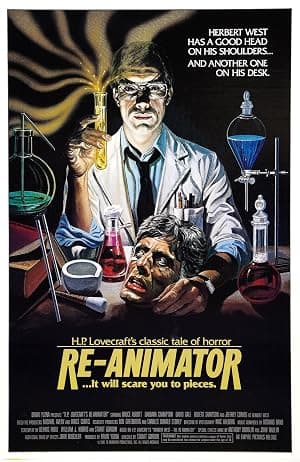
The setup
Re-Animator still arrives like a dare. It asks you to laugh, recoil and keep watching a scientist who treats death like a lab problem. Sixty-odd minutes of nastiness and invention later, you either admire its nerve—or you’re slightly disturbed in a way that keeps you thinking about it.
THE MOVIE
Herbert West is still the reason this movie works
At its simplest, Re-Animator is Herbert West’s programme. He turns his roommate’s basement into a clandestine lab, tests a glowing green reagent on a corpse and proceeds as if medical ethics were an optional footnote.
The experimental spark—the cat, Rufus, coming back to life—does the heavy lifting. It convinces Dan Cain that the formula is more than a theory and moves them from furtive tinkering to full‑on morgue experimentation.
That single-minded obsession—West’s refusal to treat death as final—gives the film its shape. Stuart Gordon directs the whole thing with surgical attention to pace and tone, and the result is a compact, aggressive 86‑minute ride that mixes science fiction, comedy‑horror and body‑splatter spectacle.
THE SETUP
The idea that sets Re-Animator in motion
There’s a pleasingly grubby logic to how the film unfolds. It’s not cosmic horror; it’s lab work—autopsies, injections and brain‑targeted shots—used as a series of escalating story mechanics.
West’s experiments rely on practical procedures and a visible reagent that, shot into fresh corpses, returns them with unpredictable and often violent side effects. Those returns are what let the film stage its confrontations.
Underpinning the escalation is professional rivalry. Tensions over credit and control—particularly with Dr Carl Hill—turn what begins as curiosity into something much nastier.
A refrigerator doubling as evidence storage, experiments getting riskier, the reagent behaving erratically: those are the ingredients that keep the plot moving without needing any supernatural hand to explain the chaos.
THE CHARACTER
Why Herbert West matters
Herbert West is the kind of character who rewires a film’s moral compass by sheer force of will. He’s intellectually obsessive, single‑minded and perfectly willing to flout medical ethics to see his experiments through.
That ruthlessness isn’t just theatrical colour; it’s the motor of the plot. West’s ambitions push Dan into complicity and make a simple scientific experiment into a series of bad decisions with bloody consequences.
West matters because he frames everything else. The world of the film is built around his experiments: the morgue confrontations, the jealous rivalries and the moral compromises that follow.
There’s also a throughline to the source material: this is a modernised take on H. P. Lovecraft’s Herbert West, transplanted into an 1980s medical‑school setting where the obsession feels as plausible as it is appalling.
THE PERFORMANCE
Why Jeffrey Combs's performance matters
Roger Ebert singled out Jeffrey Combs as a 'coolly unhinged' presence in the lead and gave the film three out of four stars.
That early critical attention mattered because it pointed to how the character needed to be played: not merely monstrous, but deliberately precise—someone who treats reanimation like a technician dealing with a stubborn machine.
The performance helps make Herbert West believable as both brilliant and dangerously single‑minded, which in turn keeps the audience invested even as the movie leans into grotesque spectacle.
UNDER THE SURFACE
Re-Animator has more on its mind than the plot suggests
On the surface you have gore and outrageous set pieces; under the skin you have debate ripe for a university debate society: who gets to decide whether death is a problem to be solved?
Playing God and scientific hubris run through the film—the experiments raise repeated moral questions about responsibility and whether certain lines should be crossed.
Friendship and complicity complicate the moral picture. Dan’s loyalty to West pulls him into the decisions that escalate the consequences, which makes the horror feel less like punishment and more like a slow disaster caused by people who could have said no.
All of this is delivered with a black‑comedy sensibility: grotesque spectacle plays for laughs as often as it plays for shock, so the film never lets you settle into a single emotional stance.
THE FILMMAKING
How Re-Animator was put together
The film wears its crew credits where you can see them: Mac Ahlberg handled cinematography, Lee Percy edited the pace, and Robert A. Burns provided production design that keeps the medical setting plausibly grim.
Richard Band’s score underpins the film’s mood; contemporary reporting notes the music was performed by Rome’s Philharmonic Orchestra, lending an oddly grand counterpoint to the often grubby onscreen business.
Those choices give the film an identity that balances low‑budget invention with professional craft: measured image‑making, tight editing and a score that treats the material seriously even when the screenplay opts for black comedy.
Put together, these elements make the film feel purposeful rather than merely lurid.
PRACTICAL EFFECTS
The effects work that gives Re-Animator its physical personality
The movie’s physical personality comes from hands‑on work: a credited practical crew created prosthetics, puppetry and mechanical solutions rather than relying on suggestion.
The headless Dr Hill sequences are a good example—those moments needed bespoke partial torsos, mechanical trickery and careful actor staging so the same performer could appear as both head and body across shots.
Effects research went the forensic route too, with references used to achieve varied corpse skin tones and textures rather than cartoon zombies.
And yes, the production is famous for its liberal use of stage blood—the accounts note unusually large quantities were used, which gives many set pieces their visceral punch.
PURE 80S
Re-Animator could not belong to any other decade
This is very much a mid‑80s project: a low‑budget independent horror film that found its early audience on the then‑growing home‑video market.
Updating Lovecraft’s 1922 story into a contemporary medical‑school setting is exactly the kind of move 1980s horror liked—transposing classic fears into recognisably modern institutions.
The production and release choices also reflect the era: a studio willing to circulate an unrated print and the tensions around MPAA classification and video distribution were part of how horror worked in that moment.
Finally, the film’s afterlife—the multiple home‑video versions and expanded cuts—also speaks to an 80s pattern where home formats allowed genre films to be rediscovered and reassessed.
WATCHING IT NOW
What has aged — and what hasn't
One thing that helps Re-Animator today is accessibility: restoration releases and expanded cuts on home video have invited fresh comparisons and reappraisals, so it’s easy to see exactly what the film was doing.
The core relationships—West dragging Dan into complicity, and the moral friction that creates—still have teeth. The dynamic keeps the story personal when the set pieces could otherwise overwhelm it.
Early reviewers were broadly positive and the film built a cult following through theatrical and home‑video play; that continued attention is part of why it survives as more than a curious period piece.
If you’re watching now, expect the film’s strengths to be its ideas and its appetite; the versions you choose (theatrical or expanded) will affect how complete the experience feels.
THE LEGACY
Why Re-Animator still matters
Re-Animator’s afterlife is a mixture of film‑fan devotion and continued creative partnerships: the film spawned two sequels and cemented a recurring collaboration between Stuart Gordon, Jeffrey Combs and Barbara Crampton.
It’s also become a cult landmark in 1980s horror circles, turning up on retrospective lists and arriving in multiple restored home‑video editions.
Even beyond screen releases, the story reached other formats: a stage musical adaptation opened in 2011 with the director’s participation, which is a neat testimony to how the material keeps inspiring reinvention.
Taken together, those things explain why it remains a touchstone for fans of black comedy and grotesque, hands‑on horror.
THE VERDICT
Does Re-Animator still hold up?
Yes—if you come for invention, nerve and a central character who won’t apologise. Herbert West’s experiments (starting with the green reagent and the reanimated cat that drags Dan in) still provide a satisfyingly direct premise.
The film’s moral engine—West’s ambition clashing with Dan’s loyalty and Megan’s entanglement through personal ties—still gives the nastier moments a human cost, so the body horror remains grounded in choices rather than spectacle alone.
Technically, the film’s practical work and the theatrical narrowness (an 86‑minute initial cut) keep the pace brisk; contemporary reviewers recognised this—Roger Ebert pointed to Combs’s unnerving lead as a large part of the film’s success.
If you’re deciding whether to watch: go for the audacity and the moral mess. Re-Animator still works because it isn’t content simply to shock; it asks you to watch people make bad decisions and then live with the consequences.
Share this movie
Keep watching
More movies from the 80s
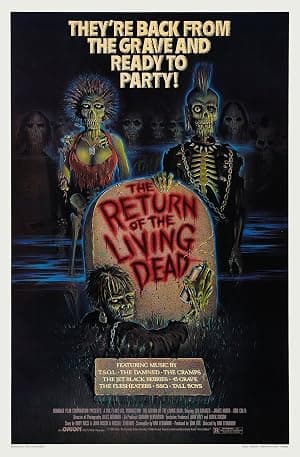
1985
The Return of the Living Dead
Brains, bad decisions and Burt — a punky, gory little time-bomb.
Read our take →
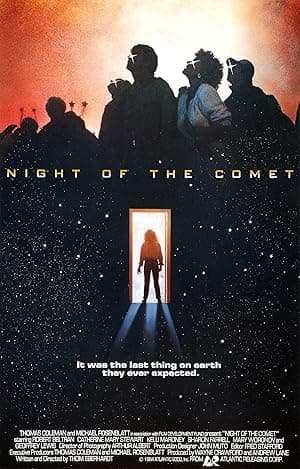
1984
Night of the Comet
Sisters, malls and a comet — Night of the Comet is a B-movie that learned how to be fun and oddly wise about survival.
Read our take →
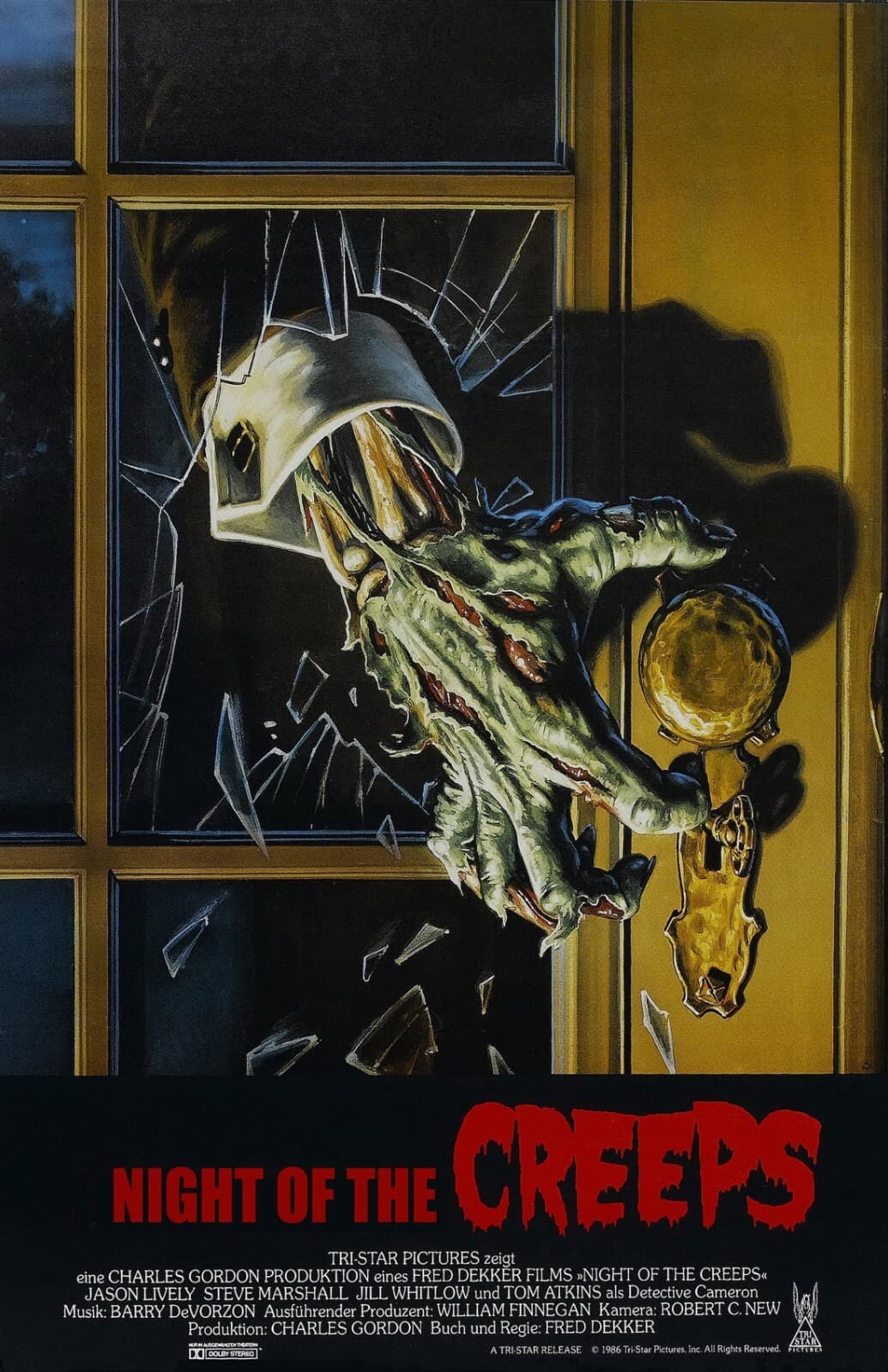
1986
Night of the Creeps
Night of the Creeps: the safety of home and mortality, and why this 1986 movie still matters.
Read our take →