The setup
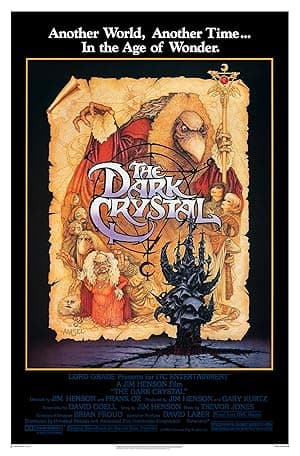
The Dark Crystal asks you to believe in a very particular kind of fairy tale: one driven by prophecy, full of strange beasts and stitched together by hands, not pixels. It’s a film people return to because its central promise is simple and stubborn — a lone Gelfling must mend the thing that holds his world together — and because Jim Henson and Frank Oz build that promise out of design and craft rather than star wattage.
THE MOVIE
Jen (voice) is still the reason this movie works
What people keep talking about, even decades on, is the idea of a single, obedient Gelfling sent out to repair a world. Jen’s task — return a lost shard to the Dark Crystal and so restore balance to Thra before a prophesied conjunction — gives the film a clean, urgent spine.
That urgency arrives as both a personal duty and a species-level responsibility: Jen is the last known Gelfling of his line, ordered by the dying Mystic to seek Aughra and fix the Crystal. It’s a tidy, almost old-fashioned quest engine, but it’s also quietly grim; the mission isn’t optional. There’s survival wrapped up in obedience.
You can see why Henson and Frank Oz felt ambitious: they weren’t chasing star names or spectacle for spectacle’s sake. The movie is a fantasy and an adventure, but it’s built with puppetry, Brian Froud’s designs and the practical work of Henson’s Creature Shop — a world assembled from crafted parts, which makes the themes of restoration versus decay feel literal as well as metaphorical.
THE SETUP
The idea that sets The Dark Crystal in motion
At its centre is straightforward storytelling economics: a prophecy, a chosen pair and a ticking clock. Jen, a lone Gelfling raised by the Mystics, must return a shard to the Dark Crystal so Thra can be healed before the Great Conjunction hands the Skeksis permanent power.
The immediate push into the quest comes with an elemental, rather than melodramatic, inciting incident — the Dying-Master’s final charge to Jen to find Aughra and repair the Crystal. That single request is the film’s motor: no convoluted revenge plot, no tangled lineage reveal. It’s duty turned into journey.
The threats Jen and Kira face are political and ecological. The Skeksis are a corrupt ruling class trying to keep the Crystal broken and Thra weakened; their infighting supplies set pieces and a particular kind of villainy. The film stages travel, discovery and encounters with distinct corners of Thra rather than hinging on a long interior drama.
Mechanically, the story ties together three myth threads — Gelfling, Skeksis and Mystic — and times them to the Great Conjunction. Those elements keep the plot moving without turning every scene into exposition, which helps maintain the film’s pace across its 93-minute runtime.
THE CHARACTER
Why Jen (voice) matters
Jen matters because he’s an unusually quiet kind of lead. He’s not thrust into destiny for glory; his motivation is obedience to a dying order and the survival of his people. That gives the film a moral seriousness that doesn’t need a parade of speeches.
His reserve also lets the world take up weight. Kira, by contrast, brings curiosity and practical knowledge — flora, fauna, the kinds of small skills that move a quest along. The two of them fit together like tools; they’re companions whose differences make the journey credible.
The emotional stakes are sharpened by the Mystics’ presence. They are a dwindling, reluctant people whose relationship with Jen supplies both moral direction and melancholy — the feeling that the older order is passing and that the task given is urgent because help is scarce.
And while the film’s central cast is entirely puppet-performed, that very constraint is a strength: character comes as much from physical craft and design choices as from words, so Jen’s significance is carried through what he does and where he goes as much as anything he says.
UNDER THE SURFACE
The Dark Crystal has more on its mind than the plot suggests
On the surface it’s a quest. Underneath it’s a negotiation between repair and entropy: restoration versus decay isn’t just a plot objective, it’s how the film organises its images and conflicts. Everything damaged asks to be mended — or exploited.
Corruption and power live on the Skeksis’ side of the ledger. Their appetite for control is framed against Thra’s fragility, which gives the film a political edge: the story isn’t merely about a shard, it’s about what happens when those in charge hoard what keeps a world whole.
Myth and prophecy drive the narrative in classic fashion — the Great Conjunction and the chosen-hero structure are the engines that justify action and urgency. That mythic scaffolding gives the film scope; it feels like something older than any of its characters.
There’s also a strong sense of nature as an animate presence, and a willingness to use fear within a children’s tale. It doesn’t shy from unpleasantness; the film treats peril as real rather than theatrical, which keeps the stakes emotionally honest.
THE FILMMAKING
How The Dark Crystal was put together
This is Henson and Oz working at a different scale from television puppetry. Concept and creature design were driven by Brian Froud, with production design help — a deliberate attempt to translate illustration into filmed reality.
Translating those drawings into moving pictures required collaborators who could bridge art and camera. Oswald (Ossie) Morris is credited as director of photography and Ralph Kemplen as editor; their job was to turn Froud’s palette and Henson’s creatures into a cohesive photographed world.
That collaboration matters because it’s what keeps the film from feeling like a stage show with a camera. The directing team, designers and cinematography worked together to make Thra read as a place you can travel through, not merely a backdrop for marionette theatre.
All of which explains the film’s deliberate pace: choices about framing and sequence construction aim to sell environment and myth as much as individual beats. The craft is obvious because so much care went into matching design intent to filmed execution.
PRACTICAL EFFECTS
The effects work that gives The Dark Crystal its physical personality
The movie’s personality comes from material things. Jim Henson’s Creature Shop was expanded to fabricate the puppets and suits, using multi-operator constructions, radio and remote mechanisms and animatronic facial components to get expressive movement out of non-human faces.
Skeksis and Mystics are realised as large, collaborative constructions that combine in-suit performers with off-stage operators handling facial features and hands. That hybrid approach produces a scale and complexity you wouldn’t get from a single operator puppet.
Scale was also a practical problem solved with practical solutions: full-scale sets sit alongside miniatures, matte and backdrop extensions and optical compositing to create depth for Thra. The production deliberately avoided relying on live human performers to sell scale.
The result is tactile: the film’s world feels assembled and inhabited because everything you see was physically made and coordinated to move as part of a single ecosystem of technique and craft.
PURE 80S
The Dark Crystal could not belong to any other decade
Released in December 1982, The Dark Crystal arrived when studios were investing in large-scale fantasy and effects-driven films, but it chose a distinct path: foregrounding puppetry and creature design rather than selling the movie on a human star.
That editorial choice — to make the world and its creatures the centrepiece — is very of its moment in the sense that the 80s were a time of technical experimentation; Henson’s team used that moment to push practical craft rather than theatrical celebrity.
Production was international in scope: work and dubbing took place across 1981–1982 with location shooting in Yorkshire and studio work around the Elstree area. The film’s score, recorded with the London Symphony Orchestra in January 1982, also speaks to the era’s appetite for a cinematic, orchestral fantasy sound.
It even found recognition early on: the film won the Grand Prize for Best Fantasy Film at the Avoriaz Fantastic Film Festival in January 1983 — a sign that, even amid mixed reviews, its strange ambition landed with some audiences and juries.
WATCHING IT NOW
What has aged — and what hasn't
Modern coverage tends to single out the film’s creature design, puppetry and visual worldbuilding as enduring strengths. That’s sensible: the tangible craft still reads on-screen and rewards close looking in a way that purely digital surfaces often don’t.
At the same time, contemporary reaction already flagged a real tension: praise for technical achievement came with questions about narrative economy and character depth. Those criticisms haven’t evaporated; if anything, they’re easier to spot because the practical work is so prominent.
The film’s use of fear in children’s storytelling still feels uncompromising. It doesn’t cosy itself up; danger is real and stakes are high, which means the emotional risks remain effective for viewers willing to treat it like serious fairy-tale business.
Finally, the world’s ongoing appeal is visible in the fact that the film’s characters and Thra were later expanded into a 2019 Netflix prequel series — a reminder that the film’s imagination still invites return visits and deeper exploration.
THE LEGACY
Why The Dark Crystal still matters
The Dark Crystal matters because it left a clear technical legacy: the Jim Henson Creature Shop, developed in part for this production, became an ongoing facility and reference point for practical-effects work.
It’s also a film whose worldbuilding invited expansion. The universe around Thra has been re-evaluated and extended — in books and in the 2019 prequel series — which suggests the original film created a setting robust enough to sustain further stories.
Early recognition at festivals — the Grand Prize for Best Fantasy Film at Avoriaz in 1983 — and later reappraisals underline a continuing interest in its ambition, even when critics then and now note the film’s uneven character work.
So its legacy is practical and imaginative: a technical workshop that changed how creatures could be built for cinema, and a strange, particular fantasy that encourages other creators to return and fill in its corners.
THE VERDICT
Does The Dark Crystal still hold up?
Yes — with a rider. If you come for craft, atmosphere and a fantasy that trusts creatures over celebrity, you’ll find the film richly rewarding. Its central engine — Jen’s burden to repair the Crystal after the Mystic’s dying command — remains morally clear and narratively direct.
If you demand tight psychological complexity or fully rounded character arcs, the movie can feel thin. Contemporary critics noticed that tension: the production’s design work often outshone the story’s economy and character depth, and those observations still read as fair.
But the film’s themes — restoration versus decay, corruption and power, mythic prophecy and a living natural world — are woven into everything on-screen rather than tacked on. That structural coherence helps it survive uneven spots because the film knows what it wants to be.
So watch it for the world and the work. The Dark Crystal is the kind of 80s fantasy that didn’t aim to be charmingly disposable; it aimed to be strange, serious and materially made. For many viewers, that combination still rewards a rewatch.
Share this movie
Keep watching
More movies from the 80s
1982
Conan the Barbarian
A musclebound quest that talks about steel, fate and how to be remade by violence.
Read our take →
1982
The Secret of NIMH
The Secret of NIMH: family and parents protecting their children, and why this 1982 movie still matters.
Read our take →
1981
Clash of the Titans
A labour of gods, monsters and one man who won't be pushed around.
Read our take →