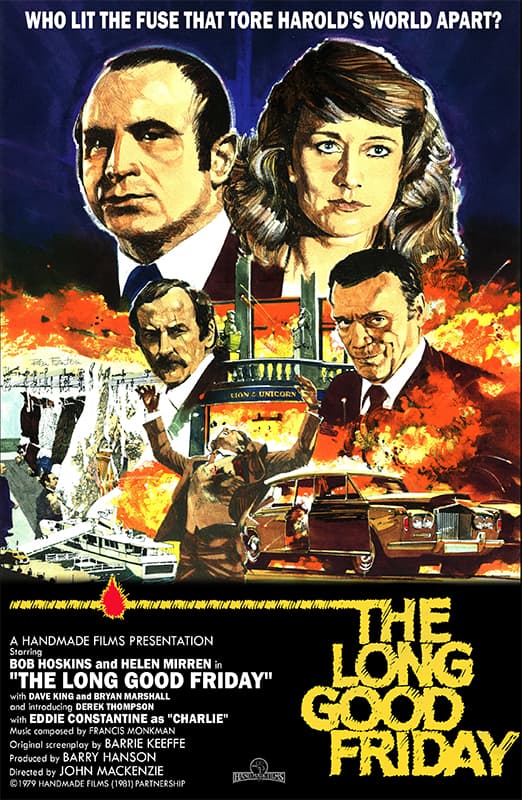
The setup
The Long Good Friday still lands because it is, at heart, a portrait of a man trying to rewrite his life by rewriting a city. John Mackenzie and Barrie Keeffe set Harold Shand on a collision course with forces he only half-understands: business, politics and violence all wrapped up in one long Easter weekend. Watch it for the tension between respectability and criminality — and for how that tension makes Harold impossible to forget.
THE MOVIE
Harold Shand is still the reason this movie works
There are plenty of memorable pieces in The Long Good Friday — the Docklands talk, the recurring sense of something off-stage getting closer, the way the film pins a crime saga to London’s imminent redevelopment. But what makes the whole thing click is Harold Shand himself: an East End boss who has decided he doesn’t want to die the way he came up; he wants legitimate deals, American investors and the kind of respect that has nothing to do with fear.
That desire — to convert a criminal empire into property deals — is the engine. It’s what drives his meetings, his demands and the brittle pride that sits behind his decisions. And the more Harold pushes for respectability, the more vulnerable he becomes when a string of bombings, deaths and sabotage start to target his people and his properties, threatening the American investment he’s trying to secure for a Docklands project.
John Mackenzie directs the story with a steady hand, and Bob Hoskins and Helen Mirren supply the centrepiece: Harold and Victoria, a partnership where loyalty and practicality are frequently the film’s quiet commentary on ambition and risk. That pairing — and Harold’s single-minded climb toward legitimacy — is why people still talk about this movie.
THE SETUP
The idea that sets The Long Good Friday in motion
The basic proposition is straightforward and smart: Harold Shand is a crime boss who has set his sights on real estate. He wants to turn the muscle and networks of organised crime into a legitimate property-development operation — and crucially, he’s trying to bring in American money to do it.
That plan gets attacked from the outside. Over a long Easter weekend Harold’s associates, buildings and deals are hit by bombings, deaths and acts of sabotage. Those disruptions aren’t just pressure on his cashflow; they unravel the confidence he needs to convince outsiders — especially the American investor he’s courting — that he has moved beyond the street.
What makes the setup work is the way the screenplay ties Harold’s ambitions to the real-world anxieties of late‑1970s/early‑1980s London. Docklands redevelopment, tangled links between organised crime and official channels, and paramilitary activity all sit behind the trouble Harold faces, turning what could be a simple power struggle into something messier and political.
The film uses its locations and the looming Docklands project as more than backdrop: they’re the map of Harold’s plan and the terrain he’s trying to possess. When those sites are attacked, the story isn’t just about lost cash — it’s about a violent pushback against Harold’s attempt to become respectable.
THE CHARACTER
Why Harold Shand matters
Harold Shand matters because he’s not content with being feared; he wants to be accepted. That appetite — the ambition to graduate from gangster to businessman — structures almost every choice he makes, and it’s what makes him interesting rather than merely dangerous.
His relationships do the rest of the work. The friction between how his lieutenants practice crime and how Harold wants to practise business exposes his pride: he’s the man who needs to be in control of both the boardroom and the street, and those demands create cracks in his authority.
That tension turns Harold into a character to watch. He’s a figure built on contradiction: ruthless in defending his position, yet eager to be seen as respectable; loyal to a point, but pushed into situations where loyalty leads to costly mistakes.
Put simply, Harold is memorable because the film makes his ambition personal rather than abstract. He’s not just a gangster with plans — he’s a man betting his future on being accepted by a world that has the power to refuse him.
THE PERFORMANCE
Why Bob Hoskins's performance matters
Contemporary reviewers made a lot of the way Bob Hoskins embodied Harold Shand, and for good reason: critics saw the part as more than an exercise in menace. The response singled out the performance as a breakthrough that made the character feel fully realised on screen.
Roger Ebert — among others — emphasised how alive the character felt as a result, using the performance as a central selling point for the film. That kind of attention matters because it shifted the conversation from plot beats to personality: Harold isn’t just a plot device, he’s a presence.
Because Harold’s ambitions and pride are so central to the story, Hoskins’s depiction of the role gives the screenplay somewhere urgent to land. The reviews’ focus on the performance helped anchor the movie in the moment and made Harold the element people returned to afterwards.
If you’re watching the film now, the reason to lean into the performance is that it’s the lens through which the movie’s conflicts — business versus crime, loyalty versus self-preservation — become human and immediate.
UNDER THE SURFACE
The Long Good Friday has more on its mind than the plot suggests
On the surface it’s a crime drama; underneath it’s a film about the awkward marriage of street power and formal capitalism. Harold’s push to make property deals is where the movie’s interest in legitimacy versus criminality sits: can someone built on intimidation ever become respectable by joining the market?
Ambition and pride are the engines. Harold’s hunger for status makes him take risks and issue ultimatums that would be unnecessary if he were content to remain a local potentate. That pride narrows his options and makes betrayal feel almost inevitable.
Loyalty and betrayal play out in both private and public ways. As attacks mount, trust within Harold’s network collapses — and that erosion of confidence is more devastating to his project than any single bombing.
Finally, the film leaves space for a political reading: the collisions between paramilitary violence and business interests place the personal story of Harold against a backdrop of wider social change — redevelopment, contested authority, and the uncertain ethics of an economy that rewards swagger as much as skill.
THE FILMMAKING
How The Long Good Friday was put together
John Mackenzie’s direction keeps the picture lean and forward-moving. The film doesn’t linger for the sake of mood; it pushes its narrative along with a kind of clipped momentum that suits the tightening pressure on Harold as the story progresses.
That pacing isn’t just narrative choice; it’s allied to the locations the film uses. By working in and around the docks and other soon-to-be-developed urban spaces, the direction ties plot urgency to the physical world Harold is trying to claim.
The result is a movie that feels grounded in place: the direction makes the Docklands and the city’s rougher corners part of the plot’s logic, not just scenery. When locations are threatened, the audience understands the stakes because the film has already treated those sites as assets.
In short, Mackenzie’s approach keeps both story and setting in step: brisk storytelling married to location work that underlines the film’s focus on redevelopment and enterprise.
PURE 80S
The Long Good Friday could not belong to any other decade
Although completed in 1979 and released around 1980, the film wears its moment on its sleeve: the story entwines docklands redevelopment and the language of enterprise that became louder at the start of the 1980s. Harold’s project is not only a personal ambition; it reflects a public conversation about money, investment and urban change.
That linkage is why the film feels of its time. It blends street-level realism with organised-crime plotting and a political subtext about who gets to profit when a city changes — a combination that positioned the movie within a renewed strand of British gangster cinema at the decade’s turn.
The fact that the film premiered at the BFI festival in 1980 before reaching general UK release also ties it to that transitional moment in British filmmaking, when stories about urban decline and entrepreneurial aspiration began to dominate certain conversations.
So, while the movie is a character study and a thriller, it’s also a timestamp: it captures the uneasy idea that development and criminal opportunity could be two sides of the same coin as London prepared to reinvent parts of itself.
THE LEGACY
Why The Long Good Friday still matters
The film keeps turning up in curated lists of significant British cinema, and that repeated recognition helps keep it in the conversation about how British film grappled with crime, class and urban change at the end of the 1970s and start of the 1980s.
HandMade Films’ role in securing a theatrical release after distribution trouble is part of the picture’s early afterlife, and it’s often mentioned in histories of the studio as one of their early notable credits.
Festival programmers and retrospective lineups have continued to give the film space, which is telling: its blend of character-driven drama and political texture gives programmers a clear reason to reintroduce it to new audiences.
Put simply, the movie’s standing rests on both the particularities of the story — Harold attempting to go legit while under attack — and the way it captures a moment when urban redevelopment and violence overlapped in public debate.
THE VERDICT
Does The Long Good Friday still hold up?
Yes — if you’re interested in a film that uses a character’s ambition to illuminate a wider set of social anxieties. The Long Good Friday’s premise is compact and powerful: Harold Shand tries to turn a criminal empire into legitimate property deals, and when bombings, deaths and sabotage threaten his American-backed Docklands project, the stakes become both personal and public.
The movie’s central mechanic — Harold juggling criminal loyalties, political contacts and high-stakes negotiations with an American figure while he’s under attack from an unknown adversary — still delivers tension because it forces him into decisions where pride and practicality collide.
Bob Hoskins is in the middle of it all, and contemporary reviewers singled his central performance out as a defining element; Helen Mirren’s Victoria remains an important counterweight, a partner whose loyalty and practical influence are repeatedly emphasised. Together they keep the film honest about both its plotting and its human cost.
So should you watch it today? If you like your crime movies lean, city-minded and character-led — if you want a portrait of ambition that refuses to sentimentalise its fall — The Long Good Friday still repays the time. It’s a film about a man trying to buy respectability in a changing city; and as the pictures of power go, that’s a dangerous purchase to make.
Featured in
Explore more about The Long Good Friday
Share this movie
Keep watching
More movies from the 80s
1983
Scarface
A refugee's hunger for respect turns into reckless rule — and a very expensive mess.
Read our take →
1987
The Untouchables
A straight-arrow in crooked times: mentorship, morality and a very noisy stairwell.
Read our take →
1980
American Gigolo
Armani, a hit single and a loneliness you can almost wear.
Read our take →