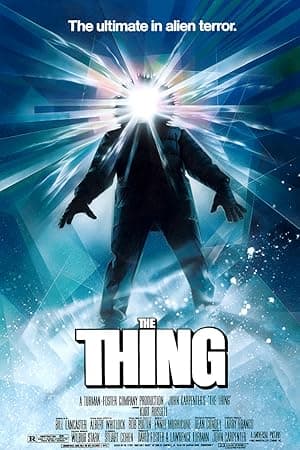
The setup
You don't need the release date to recognise The Thing: you remember the cold, the tests, and the moment everyone realises the threat can be dressed in human skin. John Carpenter's Antarctic claustrophobia pairs one practical, stubborn protagonist with an idea that steadily eats away at trust — and that's why people keep coming back.
THE MOVIE
R. J. 'Mac' MacReady is still the reason this movie works
Most conversations about The Thing start with the same uneasy image: a friendly face that might not be a face at all. The film sets that uneasy bargain up from the opening by placing R. J. 'Mac' MacReady at the centre of a closed Antarctic world where an alien can copy any organism it touches.
The inciting flap — a frantic Norwegian helicopter and a sled dog the Americans take in — looks small until you remember what it does to the group's basic assumptions. That dog is the tidy mechanical click that turns companionship into suspicion and forces the station's crew to treat one another like hazards.
What keeps the film moving isn't spectacle on its own, it's the way leadership and trust shift as the situation deteriorates. MacReady begins as a practical, improvising pilot and becomes the person people reluctantly look to when formal rank and calm reasoning collapse under the pressure of not knowing who is still human.
THE SETUP
The idea that sets The Thing in motion
The basic premise is simple to explain and fiendishly effective: a shape‑shifting alien reaches a remote U.S. Antarctic research outpost and can imitate any organism it absorbs. That ability turns ordinary people into potential enemies overnight.
Carpenter's story gives us a practical means to test the problem: MacReady devises a hot‑wire blood test to see whether a body is itself or an imitation. It feels like a sensible, cold solution — and then the film spends most of its runtime showing how sensible measures still leave room for paranoia.
The hot‑wire sequence is also worth mentioning because it's not just a plot trick. It was staged with a custom floor and gimbal so the camera could move precisely around the action, turning a clinical idea into a tense cinematic set‑piece.
So the setup works by keeping the stakes contained and material: a closed base, an identified method of detection, and a rule that makes every human interaction a potential life‑or‑death gamble.
THE CHARACTER
Why R. J. 'Mac' MacReady matters
Kurt Russell is the name on the poster, but what's important is what MacReady does in the engine room of the story. He's the practical, improvising presence who keeps trying experiments and procedures when formal command frays.
As suspicion grows, formal rank — Garry's authority as base commander — becomes less useful. People start deferring to whoever will act decisively. That collapse of traditional command elevates MacReady from pilot to reluctant leader.
What makes him memorable isn't a heroic speech; it's the way the crew's dynamics pivot around him. The film stages a slow handover of responsibility, and MacReady's pragmatic choices turn him into the person with the tools — literal and procedural — to keep the group from falling apart faster.
UNDER THE SURFACE
The Thing has more on its mind than the plot suggests
At face value The Thing is a survival horror about a monster in the snow. Under the skin it's obsessively interested in what happens when people can no longer assume bodily continuity. The creature's mimicry turns identity into a puzzle: who you are can be quietly replaced at a cellular level.
That biological instability feeds paranoia. Because the alien can replicate organisms perfectly, every person becomes a possible enemy and ordinary human rituals — sharing food, sleeping in the same room — become fraught.
Isolation sharpens everything. Cut off from rescue, the crew can't outsource the problem; they must police one another. The Antarctic setting is more than scenic bleakness, it removes outside solutions and forces social collapse to be the central conflict.
And then there's the body horror: the film makes grotesque transformation a strategy rather than an occasional shock. Mutable flesh isn't decoration here; it's the language the movie uses to make identity and trust feel physically dangerous.
THE FILMMAKING
How The Thing was put together
Carpenter's direction sits on top of very deliberate technical choices. Dean Cundey and the production team used low ceilings, exposed piping and practical light sources — often flares — to compress the frame and make rooms feel smaller than they should. The result is a visual squeeze that matches the story's social squeeze.
Carpenter also reshaped the film in the edit. Production notes show he trimmed long dialogue beats in the second act and rearranged material to prioritise suspense and shock moments — which is why certain possessions and deaths arrive like jolts rather than lingering conversations.
The famous blood‑test scene is an instance where filmmaking and story mechanics meet: the sequence was staged on a custom floor and gimbal so the camera could move around samples and faces without losing the clinical precision the scene demands.
Put together, these choices make the movie feel engineered: every lighting decision, every cut, is working to reduce the space for calm reasoning and increase the pressure on the characters' choices.
PRACTICAL EFFECTS
The effects work that gives The Thing its physical personality
The film's grotesque transformations are the product of one very obvious source: Rob Bottin's make‑up and creature effects. His team delivered mechanical units, prosthetics and animated inserts that make the Thing's copying look gruesomely tactile.
Those apparatuses were elaborate: reports record large mechanical constructions that sometimes required as many as seventeen operators to function on set. It wasn't a small operation by any stretch.
Bottin's unit also used stop‑motion inserts to help sell certain movements under the supervision of his effects team. The cumulative effect is a sense of the creature as something assembled and physical rather than purely a visual trick.
There was even later debate about how this work should be classified — union arbitration records show some of Bottin's creations didn't fit neatly into local make‑up rules, which underlines how unusual the workload was for the period.
PURE 80S
The Thing could not belong to any other decade
The Thing landed in the summer of 1982 and found itself naturally compared to other films about aliens released that year. Contemporary coverage notes that its grim tone sat uneasily next to more hopeful takes on extraterrestrial contact, which helps explain its modest box‑office reception at the time.
Stylistically and technically it also belongs to the late‑pre‑CGI era of effects filmmaking. The movie chooses practical creature work as its primary language — an approach that feels of a piece with late‑70s and early‑80s genre productions where physical effects were the dominant craft.
At the same time Carpenter wasn't remaking the 1951 picture so much as returning to John W. Campbell Jr.'s novella and sharpening the shape‑shifting idea rather than the earlier film's different monstrous premise. That decision helped the 1982 film stake out a distinct identity within the longer lineage.
Because of those choices — bleak tone, practical effects, and a willingness to dwell on social breakdown — The Thing wears 1982 on its sleeve in ways that go beyond mere fashion: it reflects the era's appetite for effects‑driven storytelling that could still be disturbingly adult in temperament.
WATCHING IT NOW
What has aged — and what hasn't
When The Thing first arrived it split reviewers: almost everyone agreed the effects were wild, but many felt the tone and character work didn't land for mainstream audiences. That initial cool reception is part of the film's history.
What changed over the following decades is how audiences discovered it outside cinemas. On home video and television the movie built a steady following; its reassessment came from people encountering it more than once and realising the film's cold logic and tight set‑pieces add up to something rarer than a simple monster movie.
So in 2023 terms the movie's strengths — its mechanics of suspicion, its carefully staged tests and containment sequences, and its practical creatures — are clearer to see than they were in a single theatrical run.
Put differently: The Thing has outlived one moment of confusion about its temperament by finding the right audience over time.
THE LEGACY
Why The Thing still matters
The Thing's most obvious legacy is its afterlife on home formats: the film developed a strong cult following once it reached video and television, and later critical lists and retrospectives have regularly restored it to the top tier of 1980s horror and sci‑fi.
That renewed attention also helped the property expand: the story continued in a 2002 game and a 2011 prequel feature that revisits the Norwegian camp, showing there was narrative room to explore around Carpenter's core conceit.
Beyond tie‑ins, the film keeps coming up in conversations among filmmakers and critics. It appears on institutional lists concerned with alien films and in genre roundups, which is a sign that its combination of paranoia, survival mechanics and practical monstrosity has a lasting resonance.
In short: The Thing matters because it fused a compelling narrative rule — the alien's mimicry — with production choices that left tangible traces for later audiences and creators to rediscover.
THE VERDICT
Does The Thing still hold up?
Yes — and here's why in plain terms. The film gives you a tight, mechanically clear threat: an organism that can replicate cellular structure. The narrative then stages a series of containment, autopsy and testing moments that turn ordinary procedures into moral and practical minefields.
Those scenes matter because they force characters to choose between protocol and suspicion. MacReady, the pragmatic pilot, supplies a method — the hot‑wire blood test — and becomes the person who can impose order when formal command collapses. That structural clarity keeps the film lean and focused.
On top of that, the movie's practical craft gives the threat a physicality that still unsettles. The Thing's transformations are staged as material events, and the camera and editing choices keep us close to the consequences rather than offering easy moral distance.
So if you're deciding whether to watch it now: The Thing remains a gripping exercise in paranoia and containment. It rewards patience and attention; it's not a comfort watch, but it is a film that still has the power to make you distrust a friend and, briefly, to mistrust yourself.
Featured in
Explore more about The Thing
Share this movie
Keep watching
More movies from the 80s
1983
Christine
Obsession, adolescence and a car that won't let go.
Read our take →
1985
Day of the Dead
A bunker drama with zombies, a scientist who won a festival, and a soldier who won't listen.
Read our take →
1981
Scanners
Telepathy, corporate control and one of cinema’s most unforgettable practical stunts.
Read our take →