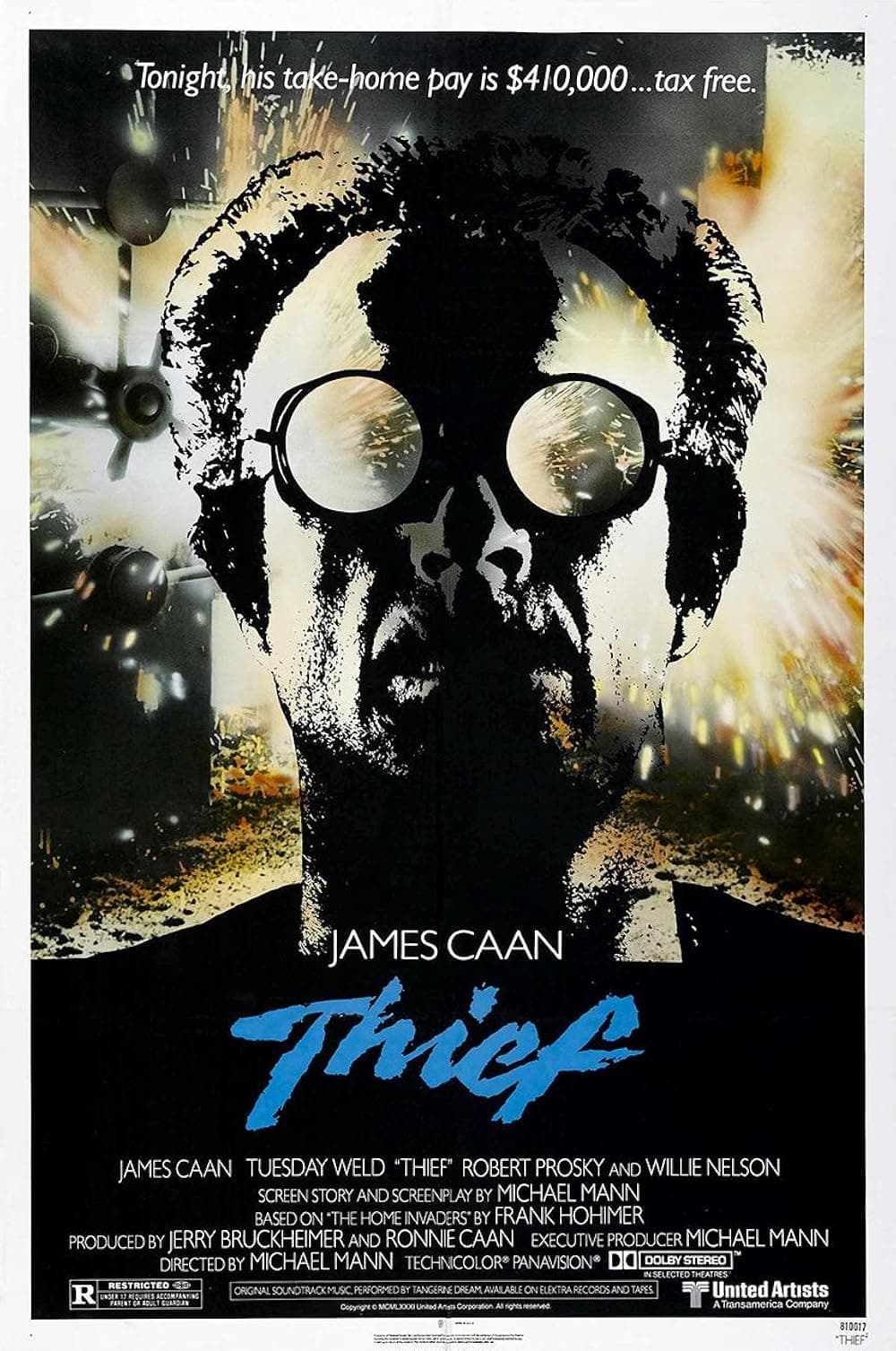
Thief (1981)
Frank can open almost any safe in Chicago. Getting out of the life proves considerably harder.
The setup
Before Miami Vice. Before Manhunter. Before Heat. There was Thief. Michael Mann's first feature film already contains so much of what would eventually make his work instantly recognisable: professionals obsessing over their craft, wet city streets glowing under neon, men living by rigid personal codes and criminals discovering that independence comes at a price. At the centre of it all is James Caan. His character, Frank, isn't dreaming of becoming a criminal kingpin. He already knows exactly what he wants: a home, a wife, children and something resembling an ordinary life. There's just one problem. Frank's exceptionally good at stealing things. And the people making money from that talent aren't particularly interested in his retirement plans.
THE STORY
One Last Job. You Know How This Usually Goes.
Frank is a professional jewel thief and safecracker operating in Chicago.
This isn't some bloke pulling a stocking over his head and waving a gun around.
Frank treats burglary like engineering.
He has equipment, preparation, trusted people and a system. His criminal work has allowed him to build legitimate-looking businesses, but the money itself isn't really the dream.
The dream is getting out.
After his fence is killed, Frank's path crosses with powerful crime boss Leo, played by Robert Prosky. Leo offers exactly the sort of arrangement Frank has spent his life avoiding: bigger jobs, bigger money and an organisation capable of making some of Frank's personal problems disappear.
Frank agrees.
Temporarily.
Which is where things begin going wrong.
Because Frank thinks he's entering a business arrangement.
Leo thinks he's acquiring an employee.
FRANK
James Caan Gives Us a Criminal Who Actually Works for a Living
James Caan reportedly regarded Frank as one of his favourite performances, and it's easy to see why.
Frank is hard without becoming a caricature.
He doesn't spend the film swaggering around telling everyone how dangerous he is. Most of the time he's working.
And Michael Mann loves watching him work.
Safecracking isn't treated as movie magic. We see machinery, metal, drilling, sparks, tools and preparation. Jobs take effort.
That physicality tells us something important about Frank.
He's proud of being good at what he does.
Maybe too proud.
Frank believes competence gives him independence. If he's the person with the specialist skill everyone needs, then surely he's the person holding the cards.
Leo is about to provide a rather unpleasant lesson in economics.
THE DREAM
Frank Has His Entire Future on a Piece of Cardboard
One of the most revealing things about Frank is the collage he carries around representing the life he wants.
Family.
Home.
Freedom.
Normality.
After spending years in prison, he has reduced his future to something almost tangible. These aren't vague ambitions to Frank. They're objectives.
That makes him strangely sympathetic despite knowing exactly how he earns his money.
Frank doesn't want a mansion filled with cocaine and gold taps.
He wants out.
But there's something sad about how mechanically he approaches happiness. He understands how to plan a robbery because every problem has a practical solution.
Life doesn't work quite like that.
You can't crack happiness open with a drill.
JESSIE
The Diner Scene Tells You Everything About Frank
Tuesday Weld's Jessie isn't merely waiting around for Frank to finish being a criminal.
Their extraordinary conversation in the diner gives the film something many crime thrillers wouldn't bother making time for: Frank actually explaining himself.
And he's not particularly good at it.
He's blunt. Intense. Occasionally uncomfortable.
But he's also vulnerable in a way we haven't seen before.
Frank spent a huge part of his life imprisoned and developed a philosophy based around needing nobody and owning nothing he couldn't walk away from.
Now he wants the opposite.
He wants Jessie.
He wants a family.
He wants something he can't simply abandon when trouble arrives.
Caan makes that contradiction fascinating.
LEO
Robert Prosky Starts Reasonable. That's What Makes Him Scary.
Leo doesn't initially look like the biggest threat in Frank's life.
That's exactly why he works.
Robert Prosky plays him with an almost paternal warmth. He has resources, contacts and opportunities. He can solve problems that Frank cannot solve alone.
For someone desperate to accelerate his way towards a normal life, Leo's offer is enormously tempting.
But generosity from a gangster generally arrives with some fairly aggressive terms and conditions.
Once Frank attempts to leave, the relationship changes.
The friendly businessman disappears.
What remains is a man who believes everything has a price — including Frank.
The mistake Leo makes is assuming Frank believes the same thing.
THE HEISTS
Michael Mann Makes Drilling Metal Look Fantastic
Few directors love watching competent people perform complicated jobs as much as Michael Mann.
Thief establishes that obsession immediately.
The burglaries aren't merely there to provide action between dialogue scenes. They're part of the film's identity.
Tools matter.
Technique matters.
Preparation matters.
Mann wants you to understand that Frank possesses an unusual professional skill, because that skill explains both his confidence and his predicament.
He isn't valuable to Leo because he's intimidating.
He's valuable because he's brilliant at something very few people can do.
And watching Caan attack a safe while sparks pour across the screen remains absurdly satisfying.
Michael Maan
His First Film Already Looks Like Michael Mann
This is the remarkable thing about Thief.
It doesn't look like a director searching for his style.
The style has already arrived.
Criterion describes the film's neon, rain-soaked imagery and attention to physical detail as establishing characteristics that would continue through Mann's later work.
Night-time Chicago glows.
Wet roads reflect signs and headlights. Industrial machinery becomes strangely beautiful. Characters disappear into darkness before emerging beneath harsh pools of light.
And the city never feels like a studio backdrop.
It's a working environment.
Frank belongs to it.
You can draw a remarkably straight line from here through Miami Vice and Manhunter all the way to Heat.
TANGERINE DREAM
The Soundtrack Drags the Gangster Film Into the 1980s
Then those synthesisers kick in.
German electronic group Tangerine Dream provided the score, combining sequencer-driven electronics with heavier guitar textures.
It shouldn't necessarily fit a gritty Chicago crime film.
It absolutely does.
The music gives Thief an atmosphere entirely different from the traditional orchestral gangster score. During the robberies, it becomes almost mechanical, matching the precision of Frank's work.
Elsewhere it gives those night-time streets a dreamlike quality.
This is where Thief earns its place as a proper 80s gangster film.
The criminals may belong to an older tradition.
The movie sounds like the future.
CHICAGO
This City Is Made of Rain, Steel and Neon
Chicago isn't simply where Thief takes place.
Mann uses it as part of Frank's character.
Factories, workshops, diners, car dealerships, bars and anonymous roads form his world. This isn't the glamorous gangster territory of expensive casinos and enormous mansions.
People work here.
Even the criminals.
Much of the movie was filmed on location around Chicago, which helps give it that tactile quality.
Everything seems wet.
Everything seems slightly dangerous.
And somehow every street has the perfect neon sign reflected in a puddle.
Michael Mann clearly discovered rain very early in his career and decided never to waste it.
Good decision.
OKLA
Willie Nelson Gives the Film Its Quietest Relationship
Willie Nelson plays Okla, Frank's mentor from his years in prison.
It's not a huge role.
It doesn't need to be.
Okla represents one of the few genuine emotional connections Frank carried out of prison with him. When Frank talks about building a family and a future, rescuing Okla is part of that picture.
It also reveals something underneath all Frank's armour.
Loyalty matters enormously to him.
That's why Leo fundamentally misunderstands the man he's dealing with.
Frank isn't driven purely by money.
There are things he values considerably more.
FREEDOM
Frank's Real Obsession Isn't Money
This is what makes Thief more interesting than a straightforward heist movie.
Frank isn't ultimately fighting for diamonds.
He's fighting for ownership of himself.
Prison took that away once.
He has no intention of allowing anybody else to do it again.
That explains the businesses, the careful criminal operation and his refusal to become part of somebody else's organisation.
Frank can tolerate danger.
What he cannot tolerate is being owned.
So when Leo begins stripping away the life Frank has constructed, Frank arrives at a brutal conclusion.
If everything you own can be used against you, perhaps the answer is to own nothing.
THE FINAL ACT
If Frank Can't Have His Life, Nobody Gets to Use It Against Him
The final stretch of Thief is where Frank's philosophy reaches its logical extreme.
Leo believes he can control him through the things Frank loves.
Frank responds by removing the leverage.
It's drastic.
It's destructive.
And from Frank's point of view, completely rational.
The businesses and possessions that represented his escape suddenly become liabilities. The future he spent years assembling has been turned into a cage.
So he tears the cage apart himself.
Then he goes looking for Leo.
At this point the careful professional thief gives way to something much simpler.
A very angry James Caan.
Not an ideal person to have walking towards your house.
WHAT HAS AGED WELL
Pretty Much the Entire Look of the Film
Thief looks fantastic.
Not "fantastic considering it was made in 1981."
Fantastic.
The night photography, practical locations, industrial machinery and Tangerine Dream soundtrack have given it an atmosphere that somehow feels both unmistakably early-80s and surprisingly modern.
James Caan's performance has aged just as well.
Frank isn't endlessly explaining his feelings for our benefit. Caan lets you see the frustration underneath him.
And Mann trusts us to keep up.
There isn't much fat on the film.
Everything is pushing Frank towards the moment when his carefully constructed plan collides with reality.
WHAT HASN'T AGED SO WELL
Frank Is Not Exactly Easy Company
Frank's intensity is part of what makes the character work.
It can also make him exhausting.
He's abrasive, controlling and capable of treating conversations like negotiations where everyone else simply hasn't realised he's already decided the outcome.
Some viewers will also find the macho worldview surrounding the film rather dated.
But importantly, the film doesn't always present Frank's behaviour as admirable.
His inability to compromise is simultaneously his greatest strength and the thing making an ordinary life almost impossible.
Frank wants normality.
He's just spent so long surviving outside normal society that he doesn't really know how to live inside it.
THE 80s FACTOR
This Is Where the Decade Starts Looking Cool
Thief arrived in 1981, but visually it already contains an entire strand of 1980s crime cinema waiting to happen.
Neon.
Electronic music.
Night-time city streets.
Cars moving through reflected light.
Professionals speaking in their own specialised language.
Michael Mann would develop these ideas much further, but they're already here.
Put it alongside our other gangster choices and the difference is striking.
The Long Good Friday shows Britain entering the 1980s.
Scarface gives us the decade's excess.
Thief gives us the decade after dark.
LEGACY
Without Thief, There Probably Isn't a Heat as We Know It
Knowing what Michael Mann eventually made makes returning to Thief fascinating.
Criterion calls it his debut feature and points directly from its style and themes towards later Mann films including Heat.
The professional criminal with a personal code.
The obsessive attention to procedure.
The conflict between work and relationships.
The nocturnal city.
The belief that attachment creates vulnerability.
It's all here.
But Thief shouldn't merely be treated as Michael Mann practising for later films.
Frank's story stands perfectly well on its own.
And James Caan makes damn sure of that.
THE VERDICT
Is Thief Still Worth Watching?
Absolutely.
And of the five gangster films we're covering, this might be the one most likely to surprise somebody who hasn't seen it.
It's not as enormous as Once Upon a Time in America.
It doesn't have Scarface's pop-culture footprint.
It doesn't have Sean Connery swaggering through it like The Untouchables.
And Bob Hoskins isn't threatening half of London.
Thief is cooler and quieter.
It's about a man who believes he can commit one final crime, collect the life he's been working towards and walk away.
We've watched enough gangster movies to know how optimistic that sounds.
Michael Mann takes that simple idea and wraps it in steel, sparks, rain and Tangerine Dream.
James Caan does the rest.
Movies in the 80s rating: 9/10
Featured in
Explore more about Thief (1981)
Share this movie
Keep watching
More movies from the 80s
1981
Absence of Malice
Absence of Malice: love and friendship, and why this 1981 movie still matters.
Read our take →
1981
An Eye for an Eye
An Eye for an Eye: courage and authority, and why this 1981 movie still matters.
Read our take →
1981
Blow Out
A detective story where the clues are on a tape, and the investigator listens harder than anyone else.
Read our take →