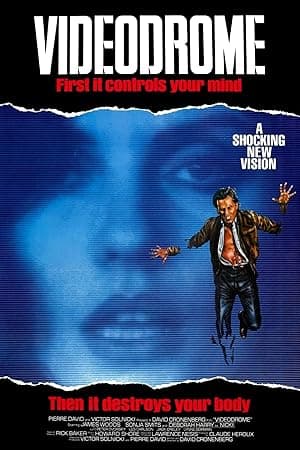
The setup
Videodrome is the sort of film that makes you squint at your own TV afterwards. David Cronenberg’s 1983 body-horror riff starts with a cable executive hunting for the next shock, and ends up turning broadcast technology into something physically dangerous and unnerving. Revisit it as a character piece as much as a scare — Max Renn's curiosity is the engine that keeps everything spinning.
THE MOVIE
Max Renn is still the reason this movie works
People keep circling back to Videodrome because it centres on someone you recognise: a TV executive who will do anything for viewers. Max Renn is the professional obsessing over what will shock a roomful of strangers; that hunger turns out to be a very dangerous engine.
Cronenberg gives us a clean, savage premise. Renn finds a pirate broadcast called Videodrome and chooses to put it on air — that decision is the spark that draws him into a mystery where broadcast signals and real life begin to bleed into each other.
You can talk about the movie as body horror, as science fiction or as arthouse provocation. But at its heart is a simple idea: television as intoxicant and weapon. With Renn pushing the buttons, the film becomes a tight study of what happens when curiosity meets something that wants to control perception.
THE SETUP
The idea that sets Videodrome in motion
At its simplest, Videodrome begins with a professional gamble. Max Renn, who runs a cable outfit hunting for provocative material, comes across a pirated signal called Videodrome and elects to air it.
That choice is the dramatic hinge: once Renn exposes his audience to the signal, odd things follow. People connected to the broadcast start disappearing or behaving in ways that suggest the tape is doing more than just entertain.
The film keeps the mystery tight by refusing to hand over easy answers. The origin of the transmission is secretive; Renn consults others who offer competing explanations about media influence, which only deepens his confusion.
Cronenberg uses videotape motifs and documentary-style inserts to make the investigation feel procedural and unnerving at the same time. Those elements also let the story blur the line between images on a screen and physical consequences in the world Renn inhabits.
THE CHARACTER
Why Max Renn matters
Max Renn isn't a blank everyman. He's a professional with ambition: his whole life orbits the idea of getting eyeballs, and he measures success by how shocking his programming can be.
That hunger makes him interesting because it doesn't feel like abstract motivation. Every decision he makes is tied to careerism and curiosity, which makes his descent — however you want to describe it — feel earned rather than arbitrary.
Renn matters because he supplies the film with a moral and psychological centre. The plot's experiments on perception only land because he willingly puts himself at the centre of them.
And finally, he's the vehicle through which Cronenberg tests the film's ideas. If the movie asks whether media can reprogram bodies and minds, it needs someone like Renn: both complicit and inquisitive enough to see how far things can go.
THE PERFORMANCE
Why James Woods's performance matters
Contemporary and later coverage consistently point to James Woods as the film’s central presence. There’s a sense that the whole movie pivots on Renn being someone you believe would chase notoriety as a business strategy.
That credibility is crucial. If Renn felt bland or passive, the film's experiment with reality and media control would lose energy; instead, the role is framed as an intensely occupied mind making choices and paying the consequences.
Woods supplies the kind of focus the material needs: he makes Renn feel like an operator, not merely a victim. That keeps viewers invested in the mystery — you want to know what a man like Renn will do next.
Put bluntly: the film needs a lead who can sell both ambition and uncertainty. The coverage of the time and retrospectives agree that Woods supplies that centre of gravity.
UNDER THE SURFACE
Videodrome has more on its mind than the plot suggests
On the surface, Videodrome is a thriller about a dangerous broadcast. Under the surface it treats media as a form of power that penetrates bodies and alters experience.
Sexuality and violence aren't decorative here; they're folded into how people consume images. The film stages desire and brutality as mediated experiences that have real, often grotesque consequences.
Cronenberg is also interested in the literal mixing of flesh and technology. The idea that bodies can be rewritten or contaminated by signal-based media gives the plot a visceral charge beyond mere metaphor.
Finally, the film continually asks where reality ends and mediated experience begins. By making that boundary porous, Videodrome forces the viewer to feel the anxiety of not trusting their own perception.
THE FILMMAKING
How Videodrome was put together
Cronenberg's aim is clearly to make video feel invasive. Production design, prosthetic makeup and mechanical effects were deliberately coordinated with video work so that the image on-screen and physical objects could feel part of the same logic.
The editing and optical techniques play a big role, too. Recorded monitors are blended with live action to make sequences that disorient the eye and reinforce the theme that media contaminates reality.
Those choices aren't cheap tricks. They are the film's shorthand for the same idea that animates the script: images don't stay on screens; they leak into bodies and behaviour.
So, the filmmaking serves the concept. When the film wants you to doubt what you're seeing it uses its toolbox — design, prosthetics and optical effects — not just exposition, to make the doubt felt.
PRACTICAL EFFECTS
The effects work that gives Videodrome its physical personality
The film’s physical persona leans heavily on makeup and mechanical devices. Rick Baker supervised prosthetic and transformation effects that are used to register Renn’s bodily changes.
Alongside that practical work the production developed video-specific distortions. Michael Lennick and his team created mechanical and tape-based effects — including a breathing-screen device — so that the on-screen image could seem to act on the actors.
What’s notable is how those techniques were combined. Prosthetics, mechanical set elements and videotape glitches are layered so that the video imagery appears to interact physically rather than simply decorating a scene.
That mix of hands-on effects and video manipulation is what gives the film its tactile weirdness: it's not just a film about signals, it's a film where practical craft makes those signals feel like a physical threat.
PURE 80S
Videodrome could not belong to any other decade
Videodrome arrived at a moment when home video and pay television were reshaping how people watched. Cronenberg’s screenplay deliberately engages the media-theory debates of that early-1980s moment, so the film feels like a response to its technological moment.
That context matters: the idea of a pirate signal spreading dangerous content tapped into real anxieties about what new distribution methods might enable.
The film also sits in Cronenberg’s ongoing run of body-horror work from the 1970s into the 1980s, a period when he was repeatedly interested in how technology and medicine could eroticise or erode the body.
Released in 1983, Videodrome reads as both a product of its moment and a concentrated reflection on the changes happening in how images circulated and affected people.
THE LEGACY
Why Videodrome still matters
Videodrome keeps turning up in retrospective criticism and film programming as an important entry in Cronenberg’s body-horror phase and in 1980s media-satire cinema. It’s the kind of film programmers and writers return to when discussing how image culture can wound.
The film was also recognised at the time: it received multiple nominations at the 1984 Canadian Genie Awards, and Cronenberg won for Best Achievement in Direction, which underlines that it had contemporary visibility beyond niche circles.
There are concrete, repeatable pieces of the film that have entered critical shorthand — its practical effects, certain visual motifs and even the phrase 'new flesh' crop up in later writing as touchstones for film and media discussions.
Taken together, those strands explain why Videodrome remains a reference point: it's repeatable, discussable and visually specific in ways that invite ongoing attention.
THE VERDICT
Does Videodrome still hold up?
Yes — but with a caveat. Videodrome remains worth watching because it equals idea and execution: it’s a compact film about a cable executive who chooses to air a pirate broadcast, and everything that follows tests that choice in bodily, psychological ways.
The film’s core conflict — Renn’s inability to tell mediated images from physical reality as the signal seems to reprogram bodies and minds — still reads as a disquieting proposition. That uncertainty is what keeps the narrative tense and the viewing experience unsettled.
The supporting figures matter too: characters who represent institutional, conspiratorial or seductive pressures shape Renn’s path and keep the drama grounded. And James Woods, widely cited as the film’s central presence, gives the movie a focus it would otherwise lack.
If you come for a sharp, short film that makes television feel dangerous and intimate at the same time, Videodrome still delivers. It’s a film about curiosity and contamination — and it leaves you looking at screens differently.
Share this movie
Keep watching
More movies from the 80s
1983
Christine
Obsession, adolescence and a car that won't let go.
Read our take →
1983
The Dead Zone
A quiet schoolteacher, an awful glimpse of tomorrow and the heavy work of knowing too much.
Read our take →
1980
Altered States
A head-trip that never forgets the man at its centre: curiosity, marriage and a tank of trouble.
Read our take →