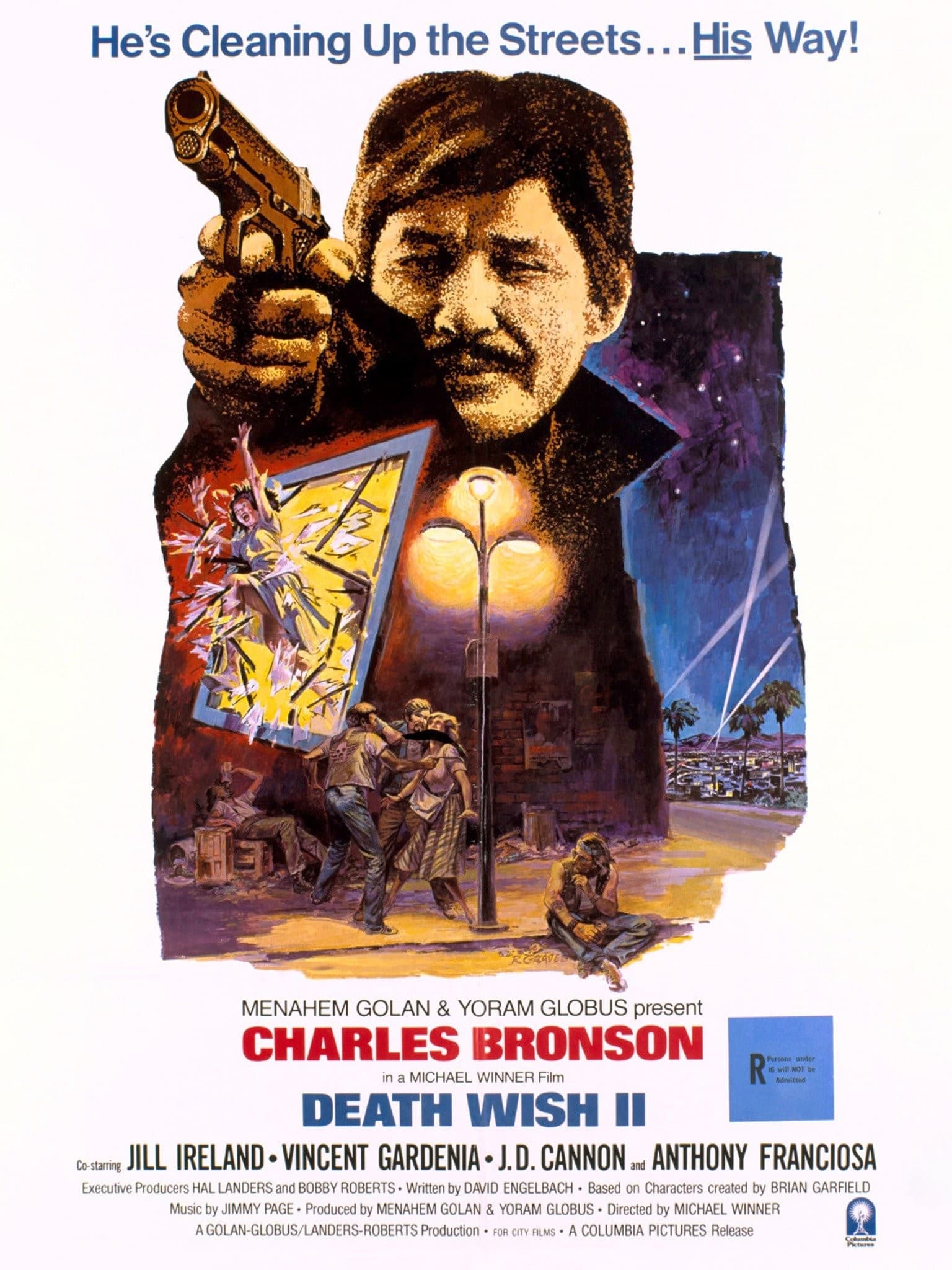
Death Wish II
Death Wish II: family and the safety of home, and why this 1982 movie still matters.
The setup
Death Wish II arrived in 1982, directed by Michael Winner. Roughly eight years after the events of the first film, Paul Kersey has recovered from his shattered life and moved on, now living in Los Angeles and working as a freelance architect. Decades later, it is worth looking at why the film still connects with audiences.
THE MOVIE
Paul Kersey is still the reason this movie works
Death Wish II was released in 1982 and directed by Michael Winner. Rather than simply retelling the plot, the film is worth revisiting for the characters, conflicts and ideas that give its story its identity.
Family, Home and safety and Authority emerge through what the characters face and the choices they make, giving the story more to explore beyond its immediate plot.
Paul Kersey, Geri Nichols and Lieutenant Frank Ochoa do not begin the film seeing one another clearly, and watching those first impressions break down is a big part of why Death Wish II still works.
THE SETUP
The idea that sets Death Wish II in motion
That part of the story matters here for a different reason than it does elsewhere in the article.
They go to pick up Paul's daughter, Carol Kersey Toby, from the mental hospital. From there, the film can concentrate less on explaining the setup and more on what happens between the people inside it.
THE CHARACTER
Why Paul Kersey matters
Charles Bronson plays Paul Kersey. Roughly eight years after the events of the first film, Paul Kersey has recovered from his shattered life and moved on, now living in Los Angeles and working as a freelance architect.
They spend the afternoon at a fairground, where Paul's wallet is stolen by a gang led by Charlie "Nirvana" Wilson, including Punkcut, Stomper, Cutter, and Jiver.
The gang splits up when Paul chases them.
THE PERFORMANCE
Why Geri Nichols matters
Jill Ireland plays Geri Nichols. One of his clients is close friend Elliot Cass, who owns a radio station for whom he is designing a new building, and he is dating one of its reporters, Geri Nichols.
That relationship helps define Geri Nichols beyond the immediate plot mechanics.
Ochoa enters Geri's apartment and tells her about Paul's previous vigilante killing spree in NYC.
UNDER THE SURFACE
Death Wish II has more on its mind than the plot suggests
Death Wish II has more on its mind than the basic setup suggests. family sits close to the centre of the film, but it is explored through the characters rather than treated like a lesson.
the safety of home matters just as much. The film keeps challenging the assumptions its characters make about one another, which is where much of its emotional weight comes from.
There is also plenty here about authority and mortality and lifespan. Those ideas overlap rather than sitting in separate boxes, which helps the movie feel like a story about people rather than a checklist of themes.
PURE 80S
Death Wish II could not belong to any other decade
Death Wish II could hardly be separated from the decade that produced it. Released in 1982, it carries the attitudes, style and filmmaking rhythms of the 1980s without needing to announce them.
It also sits comfortably within the era's action, thriller, rape and revenge, crime and vigilante filmmaking, even if the movie itself is more interesting than any single genre label suggests.
That is part of why it still appears in conversations about 1980s movies and 1980s action movies. The film has become tied not only to its own story but to the wider memory of what 1980s movies felt like.
WATCHING IT NOW
What has aged — and what hasn't
Watching Death Wish II now means seeing both what has lasted and what unmistakably belongs to 1982.
What still works best is the human material. Ideas around family, the safety of home and authority have not stopped being relevant simply because the clothes, language and cultural references belong to another era.
Some moments inevitably land differently for a modern audience. Revisiting an older film properly means enjoying what still works without pretending every choice has aged equally well.
THE LEGACY
Why Death Wish II still matters
A large part of that staying power comes from the characters. Paul Kersey, Geri Nichols and Lieutenant Frank Ochoa are still useful shorthand for the personalities and pressures the film explores.
Death Wish II has lasted because people continue to recognise something in it. Nostalgia helps, but nostalgia alone does not keep a movie in the conversation for decades.
THE VERDICT
Does Death Wish II still hold up?
So, does Death Wish II still hold up? Yes — although watching a film from 1982 honestly means accepting that not every moment will land exactly as it once did.
The film still has something recognisable to say about family, home and safety and authority, and its characters stop those ideas from feeling abstract.
Death Wish II remains worth revisiting because characters such as Paul Kersey, Geri Nichols, Lieutenant Frank Ochoa, New York City District Attorney and New York City Police Commissioner still feel like people rather than labels once the film gets underneath the stereotypes.
Share this movie
Keep watching
More movies from the 80s
1982
48 Hrs.
Two days, one cop who cuts corners, and the partner he absolutely didn't ask for.
Read our take →
1982
Blade Runner
Four engineered years, a handful of memories and a detective who isn’t sure he wants to do his job.
Read our take →
1981
Blow Out
A detective story where the clues are on a tape, and the investigator listens harder than anyone else.
Read our take →